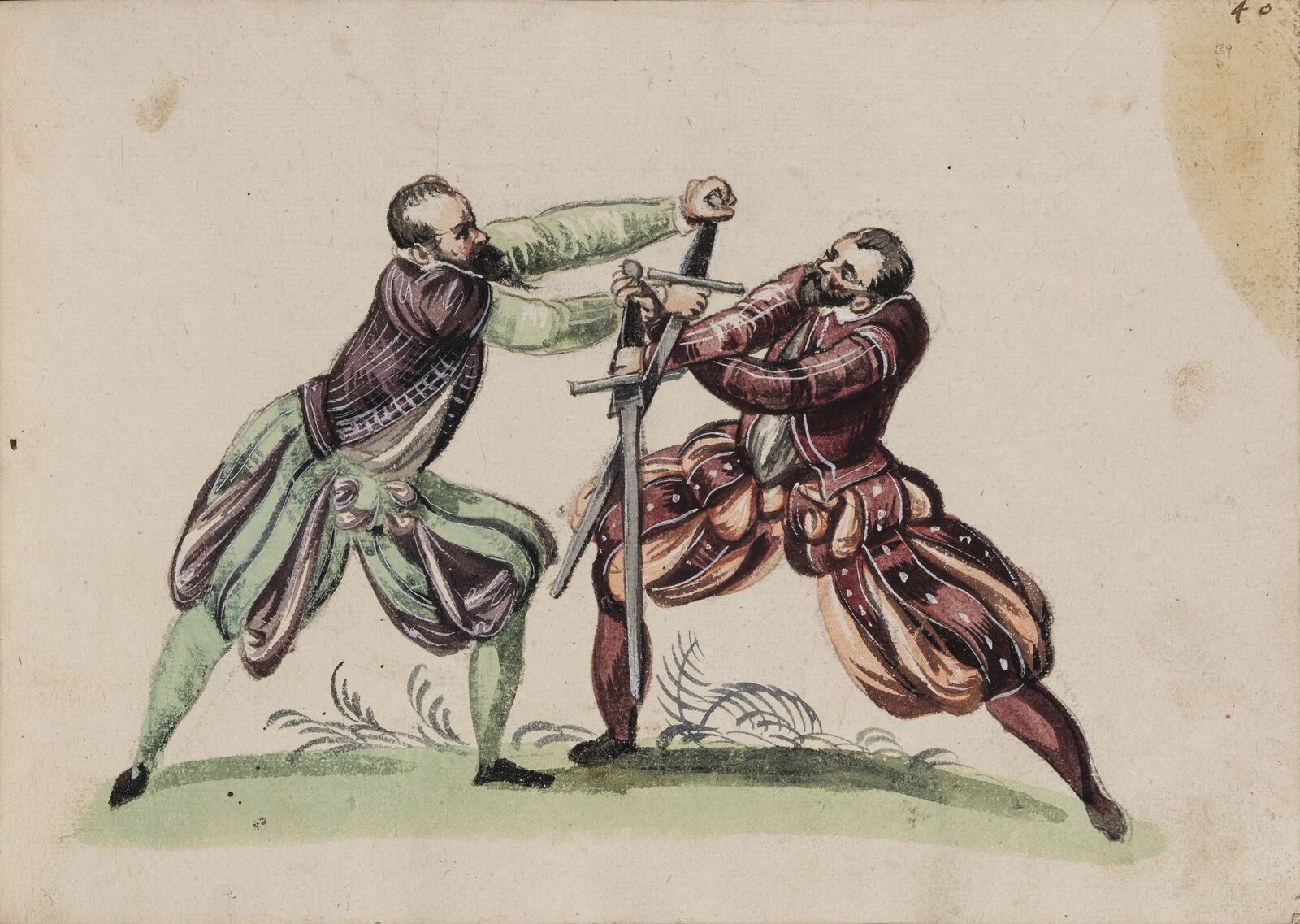
Firstly will each one of the actions in Fencing be divided into three parts which are particularly good to note. In the Sword this is namely attacking, followed by the withdrawal or other than to the first to reach it, send your attacks through the guards and cut like they follow afterwards here, however to the other parts and the middle work, this will be reprinted with the handworks, and a mixture of convenient cuts. Onwards to the last, or the withdrawal, how orderly each one will hereafter be diligently written and taught.
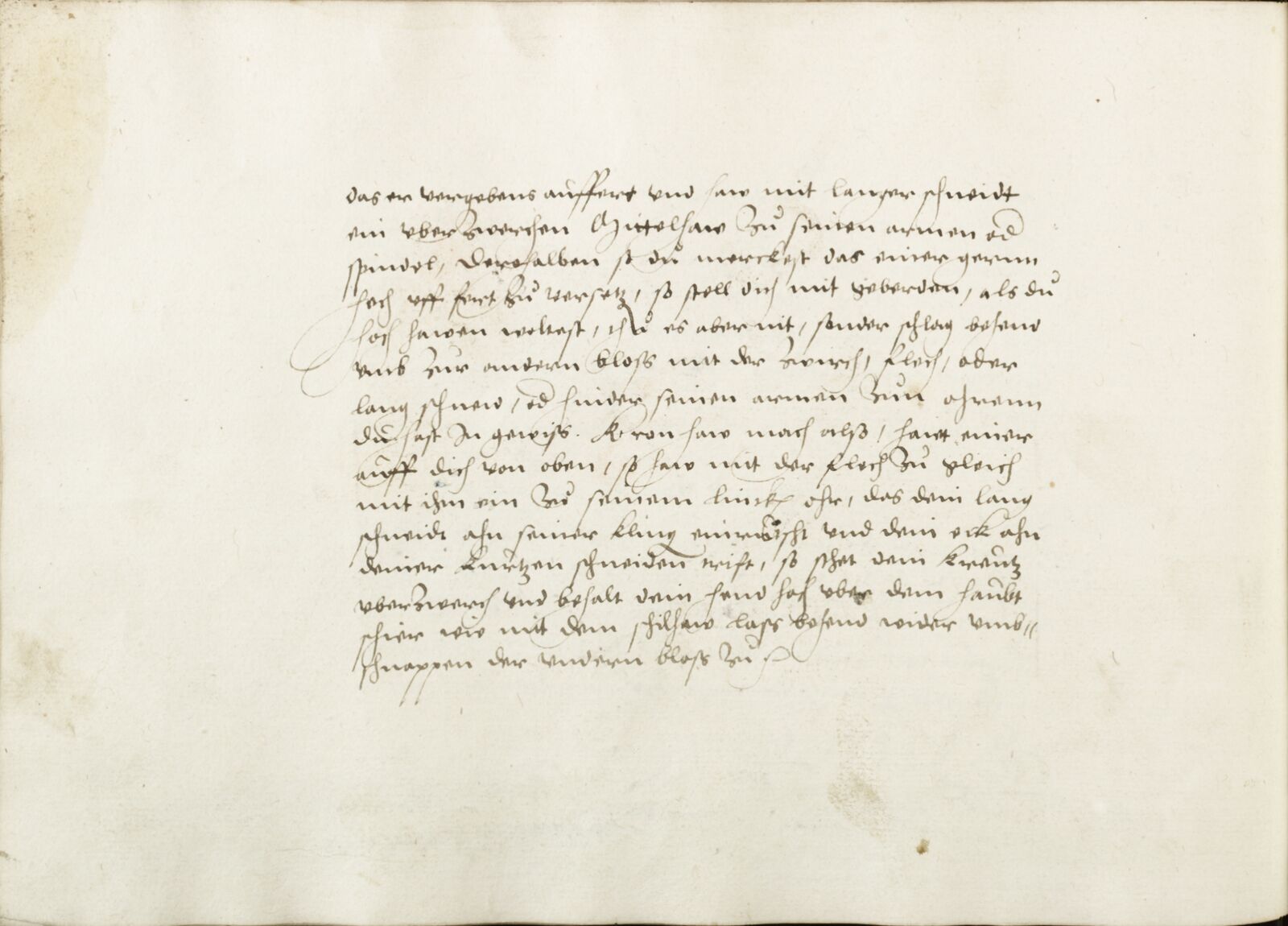
Erstlich wirt ein jeder gang in fechtenn getheilt in drey theil welches sonderlich wol zu mercken
ist in schwerdt, nemblich angreiffenn nachfolgenn, abzihenn, oder enden als zum erstenn in zugann, geschicht der angruff durch die leger unnd haw wie sie hernach folgen werdenn, in andern theil aber und mitler arbeit wirdt nachgedruckt mit der handtarbeit, und vermischung fuglicher hew. Weiter zum letsten das enden oder abzihenn wie es ordentlich ein jeder am seinem orth hernach fleissig beschribenn unnd gelehrt wurt.
6r.1
2.1linked passage
2.2
[2] Secondly one should note the Before and After, Weak and Strong. The Before is when you drive with your Stücken so that he cannot come to his senses, especially by positioning yourself close, and how he defends before your Stücken and these same would like to break and bar, with this, he runs off the Before to you. The After is, when you have been rushed upon by your opponent how it is reported next and above. Thus you should respond Indes quickly with convenient work, with this, you are strongest on his Stücken, when you lay on with your work in the Before, and in this you are crowded so that you must displace him after, thus is a constant changing with the Before and After, now you have it, then he does. But he who does not pay attention to it, he will nonetheless never learn to fence.
Lund Manuscript · fol. 6r.2
[6r.2] Zum andern sol man mercken auf das vor, und nach, schweche und stercke. Das vor ist so du den man mit deinen stuckenn dohin treibest das er zu seinem furnemen nicht khomen kan, sonder mit versetzenn sich engstenn wie er sich vor deinem stucken schutzen und dieselbenn brechen unnd sperrrenn muge, domit er dir das vor, ablauffe. Das nach ist, wan du also von deinem gegenman ubereilt wurst wie negst oder obenn gemelt, so soltu indes behendt mit fuglicher arbeit, in begegnenn, domit du in steckest in seinenn stuckenn, und also mit deiner arbeit in das vor ab jagest und in also tringest dir zu versetzenn in nach. Also ist ein steter wechsel mit dem vor unnd nach, das es jetzt disser dann jener hat, welcher auch nicht achtung darauff hot, wirdt nimmer nichts gewisses lernen fechten.
6r.2
2.2linked passage
2.3
[3] Divisions of the sword to the Weak and Strong
The sword is firstly divided in two parts, namely from the grip to the middle of the blade which is known as the Strong, from the middle to the most forward, is the Weak.
Lund Manuscript · fol. 6v.1
[6v.1] Theylung des Schwerts zur Schwech und sterck
Das schwert wirt getheilt erstlich in zwey theil nemblich vom heft bis in die mit der clingen welches ist die sterck vonn der mit bis vornen auß ist die schweche.
6v.1
2.3linked passage
2.4
[4] Furthermore is the sword divided in four parts how the figure below this shows. With the inward part, that is the haft, and [with it] the work with the pommel and cross and haft will be understood, in the next part, thereafter will the work with cutting and pushing and what belongs to the Strong be understood, to the third part of the sword should be noted the alterable work of the Weak and Strong after opportunity and liking. Which alone is extremely weak for you to work properly to the Openings.
Lund Manuscript · fol. 6v.2
[6v.2] Ferner wirt das schwert getheilt in 4 theil wie die figur hie undenn ausweist, mit dem innern theil, das ist das heft, wirt verstandenn die arbeit mit dem knopf sampt dem creutz unnd heft, in andern theil darnach wurt verstanden die arbeit mit schneidenn und drucken unnd was zur sterck gehoert. Vom dritten theil des schwerts ist zu mercken die wandelbare arbeit zu schwech und sterck nach gelegennheit und gefallen. Das ausserst ist allein der schwech zu gehoerig mit arbeitenn zur bloeß.
6v.2
2.4linked passage
2.5
[5] Hard and Soft
Thus you shall mark in the binding of the swords, as you shall feel if he has become hard or soft in the bind, with the cut.
Item: If he is yet again, strong or weak, and is usually more watchful of the weak binding before the strong, how hereafter in the fencing it can be seen.
Das soltu merkenn in banden des schwerts, do wirstu fulenn ob er hert oder weich angebundenn hab mit hewenn. Item ob er starck oder weich in widerhaltenn sey und ist sich gewonlich mehr zu hutenn vor denn weichenn dan vor denn starcken banden, wie hernach in fechtenn zu sehenn ist.
6v.3
2.5linked passage
2.6
[6] With this however the sword fencing and the following written Stuck is more understandable thus as I explain my Zedel according to the rules, as I want the words to have understanding so I have named the order; the Beginning, Middle and End.
Lund Manuscript · fol. 6v.4
[6v.4] Domit aber das schwert fechtenn unnd nachgeschribene stuck desto verstendtlicher sey so wil ich meinen nachgesetztenn zedel erklerenn wie ich die wort verstanden wil haben, nach oberzelter ordnung nemblich anfang, mittel, unnd endt.
Firstly will the opponent be divided in two sections, namely left and right, how the lines in the figure above is shown, thereafter in two more divisions namely under and over, the above two openings would be the Ox, to divide the under two, the Plow.
Lund Manuscript · fol. 7v.1
[7v.1] Von den vier Bloessen und theylung des mans.
Erstlich wirt der man getheilt in zwey theil nemblich linck und, recht wie die linien in der figur vonn obenn herab ausweist, darnach aber in zwey theil nemblich in under und ober die obern zwo bloeß werdenn dem ochsen zu getheilt die undern 2 dem pfluog.
7v.1
2.12linked passage
2.13
[13] Whose use one should thus firstly note, in which division he leads his sword under or above, to the right or the left/ when you have seen that, thus attack against him at once from above, it is about the location, otherwise, take a general example of this:
Lund Manuscript · fol. 7v.2
[7v.2] Deren sol man sich also gebrauchenn, erstlich merck in welchem theil er sein schwert furt unden oder oben, zur rechten oder lincken, wan du das ersehenn hast. So greiff als baldt gegenn uber an es sey uber eck oder sonst des nim ein exempel.
7v.2
2.13linked passage
2.14
[14] In Zufechten, thus both of you have come together, and you see that he leads his sword to his right in the high opening, in Ox or Wrath Guard, thus attack in to his lower left opening, if not, then it is much more important that you provoke him to meet you. As soon as this clashes, or will, thus pull around your head and strike him high to the opening from which he came. This is namely to his right ear, with the half edge and crossed hands. This is the correct Squinting Cut.
Lund Manuscript · fol. 7v.3
[7v.3] In zufechtenn, so ihr beyde zu samen gehet und du ersichst das er sein schwert zu seiner rechten furt in obern theil es sey in ochsen es fert oder zornhaw, so greiff in auf seiner lincken undern bloess an nit zum treffen, sonder vil mehr das du ihn reytzest dir zu begegnen, als baldt es glutzst oder riert, so zuck umb das haupt und schlag in eben zu der bloeß von welcher er khomen ist nemblich zu seinem rechten ohr mit halber schneidt und gekreutzigten hendenn.[8r.1] das ist der recht Schilhaw.
7v.38r.1
2.14linked passage
2.15
[15] Another
Thus when one holds his sword to the left in Zufechten, then go through before him from your right and cut with strength to his right, as soon as he swipes after to the strike thus pull a looping to the left opening, if he swipes after this, however, thus allow it to fly around again, thus drive each opening to the other, crosswise and against one another after your opportunity.
It is every fencer's [desire] that he quickly knows from all strikes, to which opening the cut is coming, Indes quickly there and follow after, if I however can decide, then I want to instruct about the displacing upwards in hanging.
It is stated in the ancient Verses, who often displaces, will often be injured.
So einer in zufechten sein schwert zur lincken helt, so gehe vor in durch von deiner rechten und haw mit stercke zu seiner rechtenn, als baldt er dem streich nach wuscht so zuck in einer rinde der linckenn bloeß zu, wischt er in aber nach, so laß wider umbfliegen, also furter von einer bloesse zur andern Creutzweiß unnd gegenn einander nach gelegenheit. Es sol sich ein jeder fechter gewonenn das er baldt bedicht sey von allen treffen von welcher bloeß der haw herkhomen ist. indes behendiglich dohin nachfolgenn, ee ich aber beschließ so wil ich noch die lehr vonn versetzenn hinan hencken. Es steht in den alten zedulen, wer oft versetzt, wirt oft geletzt.
8r.2
2.15linked passage
2.16
[16] Item Liechtenauer said in his secret verses, that "displacing hurts you, if you wish it on yourself", therefore shall every fencer know that he is to be the first with attacking and following, then to every fencer that is known to watch and wait on another, from this he shall come to no harm, or at the least, if he does not fight much.
A proper fencer, who does not displace much, will have the greatest advantage. Thus, when he strikes you also strike, when he thrusts you also thrust, when he steps you also step. Where two equal strikes come together, thus they bring you to displacing, when however one will cut from above, and then next he goes against with a Thwart, thus he sets off, and steps with one another, thus simultaneously should one have a step out, with the same cut and therein with advantage also pay attention to his openings. Thus should every fencer know that he is soon attentive how it is also shown above, that where two good fencers have come together, which I have attentively married together in the illustrations.
Lund Manuscript · fol. 8r.3
[8r.3] Item der Liechtenawer sagt in seinen verborgnenn wortenn fur versetzenn huet dich, geschicht es dir noth es muth dich. Darumb sol sich ein jeder fechter gewonenn das er der erst sey mit angreiffenn unnd folenden, dan ein jeder fechter der sich gewent auf ein andern zu sehenn unnd wartenn, derselbig khompt seltenn ohn schaden darvon oder auf das wenigst richt er nit fil auß ein rechter fechter aber versetzt nicht vil er hab dan grossen vortheil. So man aber schlecht so schlecht er auch. Sticht man so sticht er auch. Thrit man, so trit er auch. Dan wo zween gleich streych zu samen khomen, so bringen sie ihre[8v.1] versatzung mit, wan aber einer von oben hawet, unnd der ander hawet dargegenn mit einer zwirch. So versetzt er unnd thrift mit ein ander. Also und dergleichenn sol man ein aufscheus haben, auf die gleich hew unnd seines vortheils darinnen guth acht nemen. Dernhalben sol sich ein jeder fechter gewenen das er baldt bedacht sey wie oben auch gemelt dan wo zwen guter fechter zu samen khomen welcher iehe bedacht der zeugt ehe vor.
8r.38v.1
2.16linked passage
2.17
[17] Thus have I put forth a short and summary knowledge of sword-fighting and all noteworthy Stücken and also the translations of which the divisions that are obscured, are clarified in measure and thereafter it enters and then next goes in three divisions, namely how it was previously reported, Onset or Attacking, Pressing After or the middle work, the last is to Withdraw or end and therefore so that one may better understand I will shortly reiterate.
Thus, to the attacks have I put forth the guards in which one should not delay, or wait in them, but rather as a result must your necessary courage with whose reported cuts, go once or twice to your opportunity, so that he must then engage and that the Before has escaped Him, thus to another opening should one work after with various offensive handworks, beholding with the Before, as such handworks are stated above as a three in one handwork, thus to crowd and close so that one may come to the withdraw without shame.
Lund Manuscript · fol. 8v.2
[8v.2] Also hab ich das schwertfechtenn unnd alle nodtwendige stuck doch kurtz und summarischer weiß gesetzt und auch die wörter welche zum theil finster, etlicher massen erklert, und demnach in eim gang, und den gang in drey theil, nemblich wie anfenglich gemelt. Anfang oder angreiffen nachthrucken, oder mittel arbeit, das letst abzihenn oder enden, domit man es besser verstande wil ichs curtzlich widerholen. Also, zum angrif hab ich gesetzt die leger in welchen man nicht verharrenn soll, und darin warten, sonder dardurch auf das furderlichst angreiffen mit derenn obgemelten hewen einen oder zwen nach gelegenheit, so er nun also angreiffenn und das vor in abgelauffen ist, so soll man in andern theil nach trucken mit allerley fuglicher hanndtarbeit, das vor zu behaltenn, welche handarbeit auch oben gesetzt. Zum drittenn in mit der handtabbeit (sic) also bedrengen, unnd engsten, das man ohnn schadenn zum abzug mug khomen.
8v.2
2.17linked passage
2.18
[18] Of this, I will give an example
If one fights against you in the guard of the Roof, thus you come in Zufechten into the Side Guard, you must above all not wait in that long, then when he bears witness to the strike and as soon as he brings his sword into the air, thus lay on against him with a Thwart strike, instantly as it clashes, thus cut quickly again around with the long Thwart, to the other side of his sword, that is now attacking, if he strikes around, thus you cut after, if he displaces, then deceive him with the weak, so that you cut him in the After.
If he is hard thus you are soft If he cuts, so you counter, If he displaces, then you cut
Thirdly; also have instant attention for your opportunity to Withdraw.
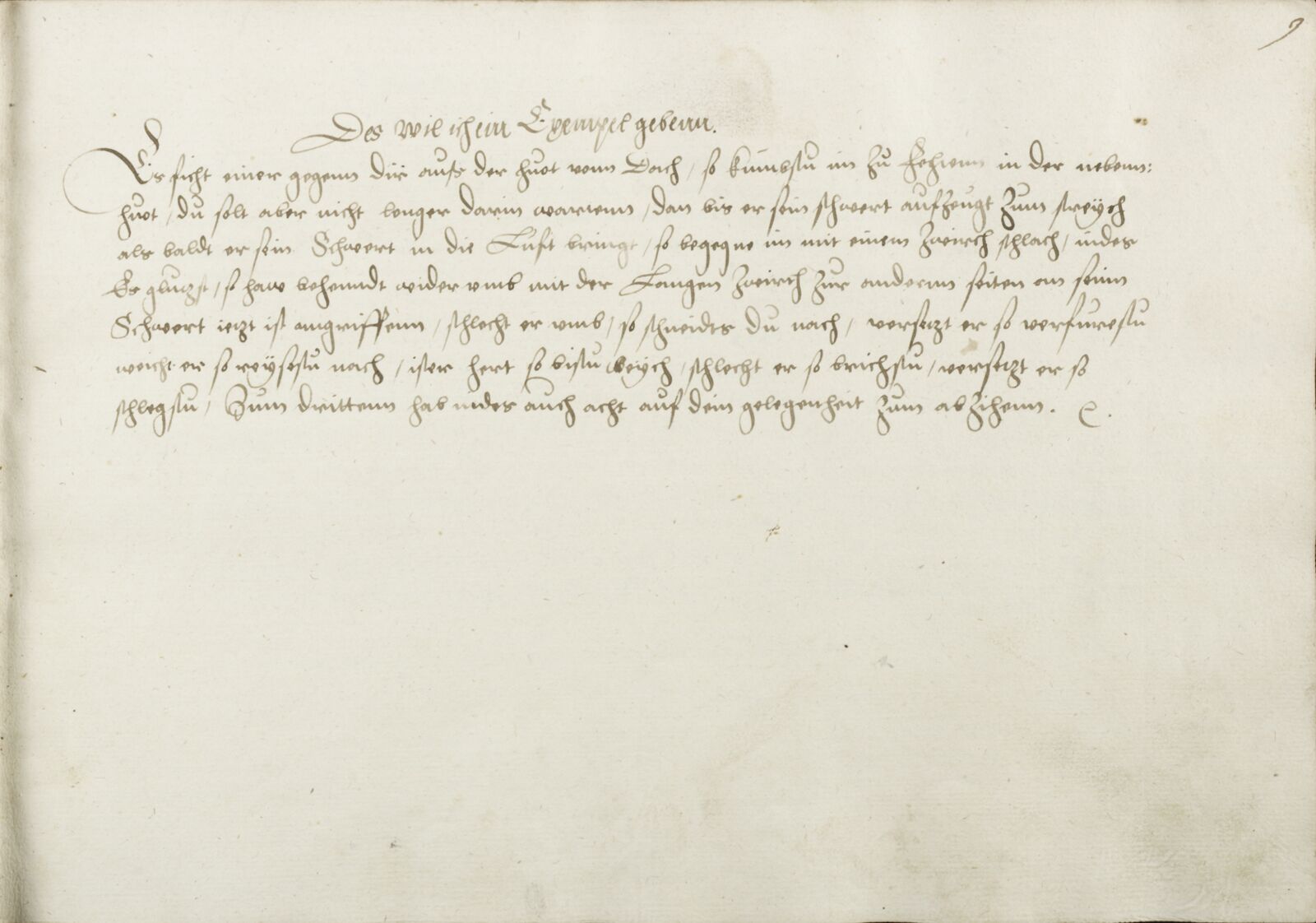
Es ficht einer gegenn dir auß der huot vonn dach, so kumbstu in zu fechten in der nebennhuot. Du solt aber nicht lenger darin wartenn, dan bis er sein schwert aufzeugt zum streych als baldt er sein schwert in die luft bringt, so begegne in mit einem zwirch schlach. indes es glutzst, so haw behenndt wider umb mit der langen zwirch zur andernn seiten an seinn schwert jetzt ist angriffenn. Schlecht er umb, so schneidts du nach. Versetzt er so verfurestu. Weicht er, so reysestu nach. Ist er hert so bistu weych. Schlecht er, so brichstu. Versetzt er, so schlegstu. Zum drittenn hab indes auch acht auf dein gelegenheit zum abzihenn. 
9r
2.18linked passage
2.19
[19] See that you are the first on the field; Before your opponent adopts a posture, lay on against him.
Thus note that when you wish to fight with someone, then see that you are the first to be in place so that you can act in a timely manner in your intended Stück, then you shall forcefully continue against him with cuts that he cannot send himself into a guard or Stück But rather you shall show that you will rush over him with sudden stepping before he realizes it. How it is then further clarified by the following Rhyme.
Lund Manuscript · fol. 10r.1
[10r.1] Schaw das der erst seyest uff dem plan, Ehe er sich legert greiff ihn ahn.
Daß merck also wan du mit einem fechten wilt, so schaw das der erst seist uff dem platz uff das du dich in deine furgenomene stuck bey zeit schicken mögest, da soltu als dhan mit hewen treiben anhaltten und sich in ein leger oder stuck zu schicken, nach seinem gefallen, sonder solt schawen das du ihn uber eylest, mit verborgnen drucken. Ehe er sein gewahr wirtt wie dan solches der nach volgent reim weitter erclertt. 
10r.1
2.19linked passage
2.20
[20] Pay heed to Instantly, understand me rightly, Hit him before he adopts his posture.
This is when you are in the Zufechten and he is just about to you, then note when he acts as if he will adopt a posture, then do not allow him to rest or come to it, but rather always attack first, and as he is choosing a posture, lay on at once to the next opening, and position yourself as if you would to cut strongly, but do not do this, rather allow it to fail or flit to another opening, then as soon as you are at the midway part of your sword on his sword, do not await, but rather, Thwart, Strike Around, Wrench Out, Slice, Wind, and what other types of work there may be.
Lund Manuscript · fol. 10r.2
[10r.2] Indes hab acht versthe mich recht, Ihn triff ehe er sein leger schlegt.
Daß ist wan du in zufechten bist, so hab acht wan er schir bey dir ist, so merck als bald er sich stelt, als wölle er sich legern, so laß ihn nit rhuen oder darzu khommen, sonder ficht inmer furtt vor ihm durch, und dieweil er seines legers wahr nimbt, so greiff ahn der nechsten blöß zu, unnd stell dich sam du starck hawen woltest thu es nicht, sonder laß fehl abgehen oder verflig zu einer anderer blöß ahn, als baldt du mitt deiner klingen zum halben theil drin bist, oder [10v] Ahn sein schwerdt khommen bist, als dan feier nicht, sonder zwirch, schlag umb reiß auß, schneidt, windt, und was dir fur arbeit mag werden.
10r.210v
2.20linked passage
2.21
[21] For you no guard will come so good In the After you strike out freely, boldly.
But it makes you wonder, as such, how can there be still many good guards, and hence, you yourself have seen taught here many good techniques, answer, it is true, there are many good guards and will be fought from a number of good and beautiful techniques. As I have included several in this book for you. However this rhyme teaches you that it is always better to not settle into a guard. It guards you not at all, to show someone with your guard, what you will do amid the fight, that may your cutting through not be brought so far.
In this, learn from the rhyme, when you should do it. Namely in the After that is when you should take him, when he keeps his guard, or stays in a guard, then cut him to the opposite opening, as soon as he goes towards your strike with his displacing, and is out of his guard, and whether it connects or doesn’t connect, then pull around your head and strike, especially to the part or quarter line from where he has struck from.
Lund Manuscript · fol. 10v.2
[10v.2] Fur dich kein leger kombt so guth, Im nach in triff auß freiem muth.
Es mocht aber einer sagen wie? Es sein doch viel gutter Leger und du selber hast viel gutter stuck darauß gelertt zu fechten. Antwort, es ist wahr, es sein viel gutter leger, und werden schaw und gutte stuck auß etlichen gefochten, wie ich dir auch etlich in dissem buch gesetzt hab. Aber disser reim lertt dich das es alweg besser ist, es leger sich einer gahr nicht, dhan man merckt ahn deinem legern, was du bey einem gleichen fechten wilt, das mag durch hawen nicht so wol gesehen werden. Zu dem so lernt dich der reim, wie du ihm thun solt, nemlich in nach, das ist, wie du ihn treffen solt. Wan er sich legert, oder in eim leger sthet, so haw ihm dargegen uber zur andern blöß. So baldt er dem haw entgegen geht auß seinem leger, deinen haw mit versatzung ahn zu nehmen. So zuck wider umb, ehe es recht ruret, oder gahr nicht ruret, umb den kopf und schlag, eben zu diessem theil oder quartal hinein von welcher er abgangen ist. 
10v.2
2.21linked passage
2.22
[22] Of this I will give to you an example: when one stands before you in the right Wrath Guard in the Zufechten, as soon as you note that he will remain in the Wrath Guard, thus cut through to him, still that you are not too close, and in cutting through, allow your sword to fly around in the air, so that you would come into the right Ox, but before you complete this, or when you have sent this gesture, then step quickly, before he will properly defend, and cut to his left, from under so that your hands remain high, with this you force him, that he must leave his guard to displace, or with a step back, cut in at the same time as you, as soon as the swords connect, pull around the head and cut with crossed hands to his right ear with a Squinting Cut, in an arc, to where his departure has made him open, how the Figure shows, it is a lofty attack or onset, in which you should take great heed to the steps, and the body should well follow the cuts.
When you threaten to cut to a place, then you can readily deceive him, therefore in such attacks you must take the ground, as it were, and in your approach act as if you would step small and tight and before he is aware step broadly forth to the attack, allow yourself at first to be seen taking large steps, in this he takes notice, and will meet you quickly in earnest, to get there before you, thus withhold your step and do it moderately, so that he is otherwise in this you take your advantage, and as soon as you see it, that you are quickly at him again with broad stepping.
Lund Manuscript · fol. 11r
[11r] Deß wil ich dir ein Exempel setzen. Einer sthet vor dir in dem rechten zornn leger. So baldt du in zufechten merckest das er sich in die zornhutt legert so haw vor ihm durch, doch daß du nicht zu nah steest und in durchhawen laß dein schwerdt in der luft verfligen. Sam du in rechten ochsen kommen woltest, ehe du es aber recht weissest, oder mit geberden dar zu geschickt hast, so thrit in eyl, ehe ers recht gewahr wirdt und haw zu seiner lincken von unden ein, das deine hendt hoch seyen, damit zwingstu ihn, das er dir entweders auß dem leger versetzen, oder mit einem abtritt zu gleich einhawen muß. Hawt er, so baldt die schwertter zusamen ruren, zuck umb den Kopf, und haw mit geschrenckten henden zu seinem rechten ohr mit einem schilhaw, in einem schwung, in dem seine abgeht der selbigenn bloß zu, wie die figur weist, es ist ein lustiger angriff oder fechten in dem du der trit gahr wol solt warnemen, und den leib den hewen wol mit lassen gehen, wan du ihn ahn ein ort trawest zu schlagen, dan das verfirt sehr und gahr baldt, darumb mustu in solchen angriffen in das erdtrich gleichsam abstelen, und in zugang dich stellen, als tretestu nah, und enge thrit, ehe ers gewahr wirt, so trittest weitt zum angriffen, herwiderumb, laß dich zum ersten mit grossen thritten mercken, in dem ers acht nimbt, und wil dir mit ernst begegnen, in eyll dir vorzukhommen, so verhaltestu dein thritt und thuest gemecher biß er sich umb sonst verzublet, in diessem nimstu deines vortheils wahr, und so baldt du den ersihest, so bistu in eyl mitt weitten thritten wider bey ihm. 
11r
2.22linked passage
2.23
[23] The cuts you send powerfully from your body To the four openings carry out your work.
In this rhyme two things are realized, firstly, to the cutting secondly, to the four openings of the Man, to which the cuts will be cut, and note that you cut all cuts with outstretched arms, and with this reach far to the man, also as soon as a cut from one side fails, thus you should quickly cut to the opposite side.
Lund Manuscript · fol. 11v.1
[11v.1] Die Hew fier gewaltig von dem leib zu den vier blossen dein arbeitt treib
Disser Reim begreifft zwey ding, erstlich, von hewen, zum andern von dem vier theiln des mans, nach welchen die hew gehawen werden, und merck das du alle hew mit außgestrecken armen thuest, und damit weit zum man reichest, auch so baldt ein haw von einer seitten fehl geht, so soltu von der andern seitten geschwindt dargegen hawen.
11v.1
2.23linked passage
2.24
[24] Item If however you step up and are going strong, thus cut quickly around to the other side, also when you will cut to an opening, thus note that as soon as he goes to displace your cut, thus do not allow them to connect, (where it is useful to you) but rather pull free your sword and let it fly around again and strike to another opening, reach far from you with the cuts, and you must step correctly with this, thus fine changing and changing through on the shield comes to you, and so you won’t be harmed see that you cut to the body and not to the sword, from the Second part of this rhyme the verses teach this, also I will write further of this in 38 rhymes, and still more of the same.
Lund Manuscript · fol. 11v.2
[11v.2] Item triffestu aber ahn, und wirst gesteckt, so schag [!] geschwind umb zur andern seitten, auch wan du zu einer bloß hawen wilt, so merck als bald er deim haw begegnet zu versetzen, so laß (wo dir muglich) nicht riren, sonder zuck frey fligendt dein schwerdt wider ab, und laß den streich zu einer andern bloß widereinfligen, wan du also mit den hewen weit von dir reichest, und nimst die thrit recht mit, so khan dir kein wechsel oder durchwechslen ahn den schilt khomen oder dir schaden so du anderst zum leib und nicht zum schwert hawest. Vom zweitten theil disses reims ist ihm ersten theil gelert. Auch wil ich in 38 Reim weitter davon schreiben, und nach mehr daselbst hin sparen.
11v.2
2.24linked passage
2.25
[25] When you Crooked Cut go up quickly Throw the point with crossed hands.
Note the Crooked Cuts are many, and that all cuts that are done with hands put crosswise or crossed, will be known as Crooked Cuts.
Hence the one, Squinter is also counted among the Crooked Cuts and it applies equally to the long or short edges, thus it is a Crooked Cut when you hold your hands crosswise.
And firstly when one will cut straight to your head, from his right, thus step with your right foot well out from his strike, to his left, so that you avoid his strike with a spring to his left and likewise cut from your right with crossed hands, against his cut, thus you come with your blade between his head and sword, on his short edge, which is facing him, and when it connects, then step further around to his left side with your right foot, and displace or transfer your sword's blade from his, onto his arm, between his head and sword, in this you will have seen the opening, to which the you may cut and see that you don't wait long but rather allow your cuts to fly quickly to the openings.
Lund Manuscript · fol. 11v.3
[11v.3] So du Khrumb hawest fahr auff behendt Geschrenckt den orth wurff uff die hendt
Merck der krumphaw seindt vielerley, dan was fur haw mit geschrenckten oder gekreutzigten henden gehawen werden, werden krump- [12r.1] haw genendt, daher der ein schüller auch under die krumphew gezelt wirtt dan es gilt gleich er mit gantzer oder halber schneidt, so ist es ein krumphaw so offt du die hendt kreitzweiß fierest, und erstlich wan einer auff dich von oben geradt zum kopf hawt von seiner rechten, so thrit mit dem rechten fuß, wol auß seim streich, auff sein linck das du seinem streich gleichsam in ein sprung auf sein linck entwischt, und haw auch von deiner rechten mit geschrencktem henden, gegen seinem haw, so kommestu mit deiner schwerdts klingen, zwüschen seim kopf umd schwerdt ahn sein klingen, auf sein halb schneidt die dhan gegen ihm sthet in dem es riret, so thrit furbaß mit dem rechten, gegen seiner lincken seitten umb, und versetze oder transferier dein kling von seiner, zwuschen seim kopf und schwerdt uff sein arm undersich in dessen wirstu gewiß ein blöß haben, zu welcher du hawen magst, und saume dich nhur nicht lang, sonder laß behend zu den blossen fligen.
11v.312r.1
2.25linked passage
2.26
[26] Item Note when you approach him in the Zufechten, then see when he shows his arm will strike, thus cross your hands while in the air yet that they remain high, and throw the point at his hand or arms, that is the weak or the furthest part of the blade, and that should happen when he goes up to strike, and before he is ready, thus be on his blade, with a Thwart Cut, for such techniques should fly and go quickly.
Lund Manuscript · fol. 12r.2
[12r.2] Item Merck wan du in zufechten zu ihm kommest, so schaw in dem er seine arm auff zihet zum streich, so verschrenck dein hendt in der luft das sie hoch bleiben, und wirf ihm den orth das ist die schwech, oder dis erst theil deiner klingen uff sein hend oder arme, das sol geschehen in dem er zum striech uff geht, und ehe er fertig ist, soltu ihm mit einer zwirch schon ahn seiner klingen sein, dan solche stuck sollen fligent und geschwindt gehen
12r.2
2.26linked passage
2.27
[27] Allow the Circle to connect to the right Hold your hands high, you will deceive him.
The Circle also comes from the Crooked Cuts and is a particularly good technique for deception, compared to others, because it does not just run off, unlike other deceptive techniques, like Running Off and the like, but rather when one does it correctly and strikes the Circle very hard with the short edge in running by.
This Stück goes thus, (after you have come under his sword in the attack) when your stay in the bind, and drive your sword over the head, as soon as he gives a little room, so that he is not binding on the sword, but rather drives his sword then high above you, then cross your hands in the air, and cut from above with the short edge thus put crosswise, down to his right ear, so that whether your blade hits or not, it runs around in a circle by his right arm, and in this keep your hands high above your head, as soon as he slips after the Circle, then step with your left foot well on to his right side, and cut in at his head with the long edge, over his right arm, behind his blade, take your body and head well away from his strike with a step to your left side.
Lund Manuscript · fol. 13r
[13r] Den Zurckel den laß riren Bhalt hoch dein hendt wilt ihn verfiren.
Der zürckel kompt auch auß den krumphewen und ist ein sonderlich guth stuck zum verfiren fur andern, dan es nit lehr und vergeben fur laufft, wie andere verfirliche stuck, als ablauffen und dergleichen sonder so man ihn recht macht, triffet der zurckel sehr hartt mit der halben schneiden in furlauff. Das stuck treib also: wan du (nach dem du mit dem angriff under sein schwerdt khommen bist) fur eim sthest in bundt, und dein schwert in der hohe ob dem haubt firest, so bald er dir platz last, das er dir nicht nach dem schwerdt bindt, sonder fiert sein schwerdt auch hoch mit dem orth uber sich, so verschrenck dein hend in der luft, unnd haw mit kurtzer schneid also geschrenckt von oben nider, zu sein rechten ohr, das dein kling gleich wol sein treff oder nicht, neben seinem rechten arm furvber in einem zurckel erumb lauff, und behalt in dessen gleichwol die hend hoch uber deinen haubt, so baldt er dem zürckel nach wuscht, so thrit mit deinem lincken fuß wol uff sein recht seitten auß, und haw mit langer schneid hinder seiner klingen uber sein rechten arm, zum kopf, nhim den leib mit dem thrit wol auß, uff dein linck seitten, mit deim haw auß seinem streich. 
13r
2.27linked passage
2.28
[28] A good Stück from the Circle
When you stand before one in this same work, how you have previously been taught, thus pay attention when your advantage will come, then step aside at once with your left foot out to your left side, and cut with a circle to his right while you are stepping but that in running past to the right, it grazes, and also with this Circle, step through with your right foot between you and him, in to his right side, with this stepping through, cut a Thwart Cut from your right to his left, forwards to the face Indes spring well out to his right and cut him long after to his head.
Wan du also wie vor gelert in gleicher arbeit fur dem man sthest, so hab acht wan dir die gelegenheit wirtt, so thrit mit dem lincken fuß zu gleich uff dein linck seitt beseitts auß, und haw zu gleich mit dem tritt ein zürckel zu seim rechten furuber, doch das es in furvberlauffen zur rechten ahn schürft, und zu gleich mit dem zürckel thrit mit deinem rechten fuß zwüschen dir und ihm uff sein recht seitten durch, und in durchtretten haw ein zwirchhaw von deiner rechten gegen seiner lincken vorn zum gesicht indes spring wol auß uff sein rechte, und haw ihm lang nach zu seim kopf. 
13v.1
2.28linked passage
2.29
[29] With the Crooked step well if you want to displace The crossing over, does him harm.
This is when you cut in Crooked at the same time as him, with your strike you should step well out from his strike, so that you have your head behind your blade, well from his strike. The second part teaches you that when you have bound on his sword with a Crooked cut, that you nimbly cross over where you have the opportunity and then snap around or wind the quick snap to his head, or wrench out, allow it to overrun.
Lund Manuscript · fol. 13v.2
[13v.2] Mit krumb thrit wol wiltu versetzen Daß uber schrencken thut ihn letzen
Daß ist wan du krumb mit einen einhauwest, soltu wol mit dem haw tretten auß seim streich, das du dein kopf hinder deiner klingen auß seim streich habest, das ander theil, lernt dich so du mit einem lincken krumbhaw ahn sein schwerdt bindest, das du behend, wo du gelegenheit darzu haben kanst, uberschrenckest, als dhan schnap umb, oder wind die schnellen noch schnap kopf , oder trifstt auß laß uberlauffen. 
13v.2
2.29linked passage
2.30
[30] A Stück from the Reversing
Note in Zufechten that you pay attention when he goes up before you, then step and cut a Crooked from your left to or above his right arm, with this Crooked Cut step well to him, and reverse your sword and wrench downwards and out to your right side If he may work further, thus drive with the pommel from inside, between both of his arms, allow your left hand to release from the grip and grab your sword blade and wrench out upwards, how this figure shows.
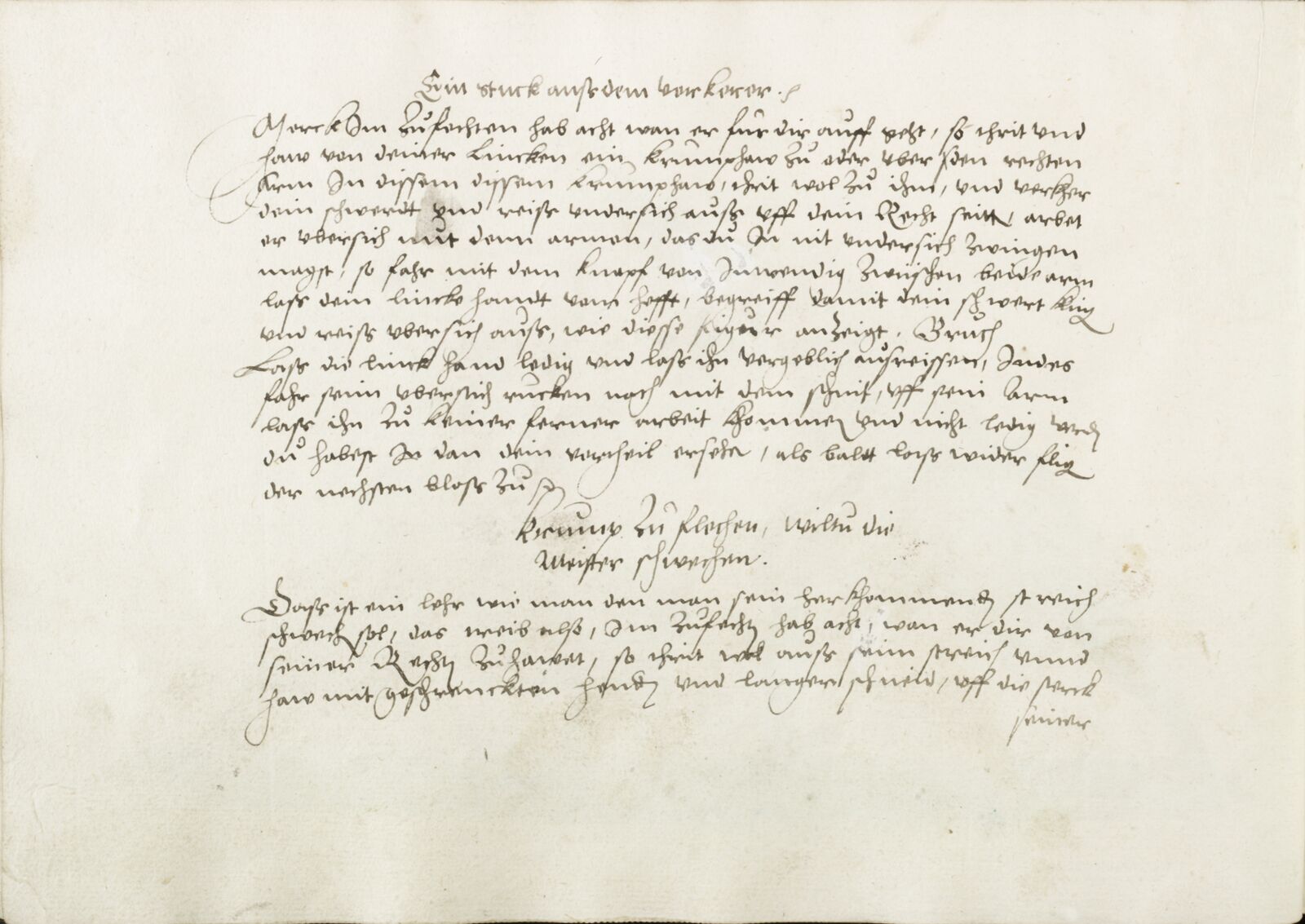
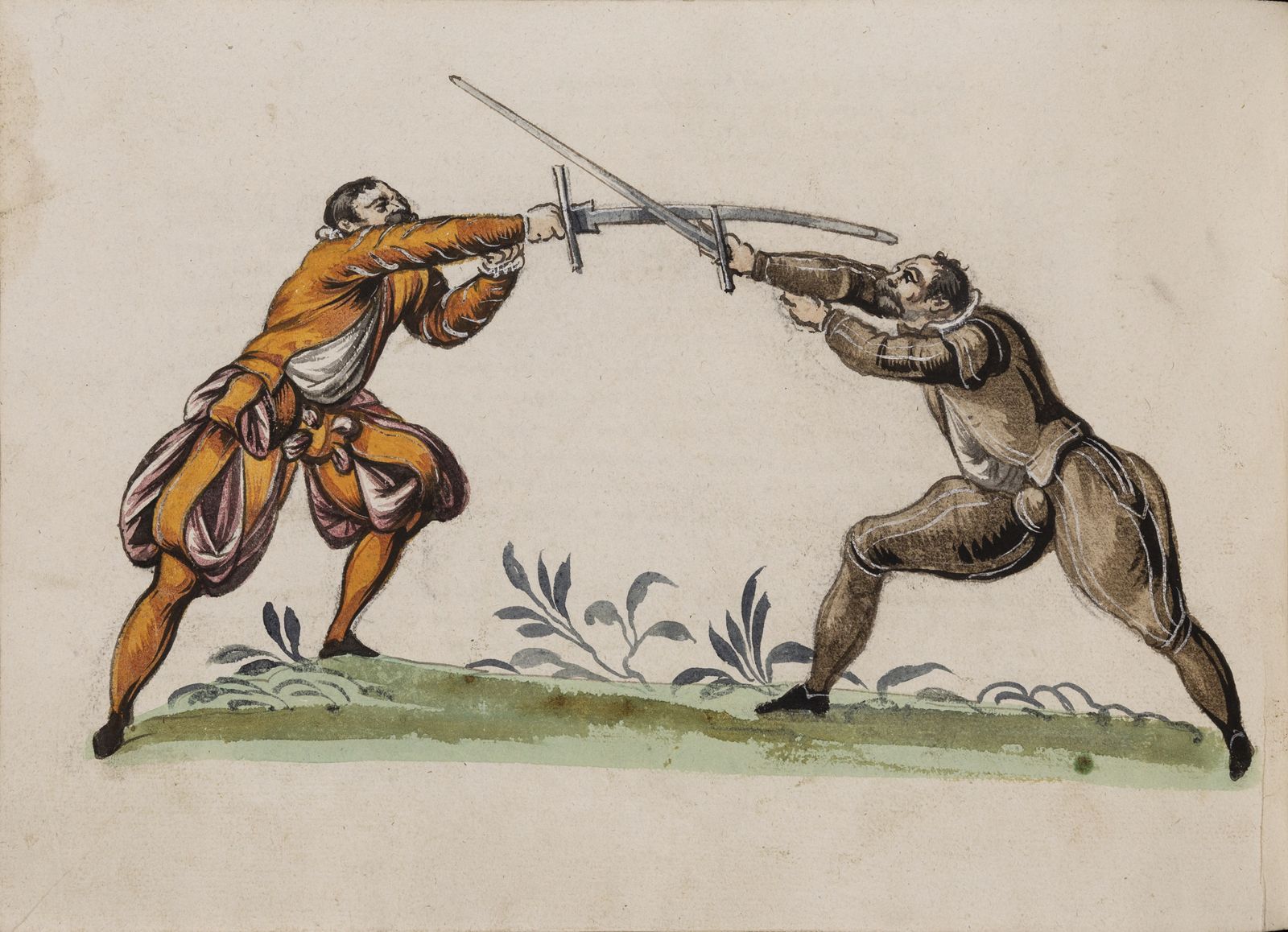
Merck in zufechten hab acht wan er fur dir auff geht, so thrit und haw von deiner lincken ein krumphaw zu oder uber den rechten arm in dissem dissem (sic) krumphaw, thrit wol zu ihm, und verkher dein schwerdt und reiß undersich auß uff dein recht seitten, arbet (sic) er ubersch mit dem armen, das du in nit undersich zwingen magst, so fahr mit dem knopf von inwendig zwüschen beide arm laß dein lincke handt vom hefft, begreiff damit dein schwert klingen und reiß ubersich auß, wie diesse figur anzeigt. 
14v.1
2.30linked passage
2.31
[31] Counter
Let go the left hand, and allow him to wrench without avail, Indes drive after his upwards pressing, with your slice to his arms, do not allow him to come to any further work, nor to cut freely, when you see your advantage, at once, allow your sword to fly to the next opening.
Laß die linck hand ledig und laß ihn vergeblich ausreissen, indes fahr seim ubersich rucken nach mit dem schnit, uff sein arm laß ihn zu keiner ferner arbeit khommen und nicht ledig werden du habest in dan dein vortheil ersehen, als baltt laß wider fligen der nechsten bloß zu.
14v.2
2.31linked passage
2.32
[32] Cut Crooked to his Flat And you will Weaken the Master.
This is a lesson how you shall weaken one's incoming strike, and goes thus. In Zufechten pay attention when he cuts in at you from his right, then step well out from his strike and cut with crossed hands and the long edge onto the strong of his sword's blade, on the Flat, thereby you weaken him, so that he can barely recover for another strike, then before he recovers you are on his head with winding and flicking.
Lund Manuscript · fol. 14v.3
[14v.3] Krump zu flechen, wiltu die Meister schwechen.
Daß ist ein lehr wie man den man sein herkhommenden streich schwechen sol, das treib also, in zufechten hab acht, wan er dir von seiner rechten zuhawet, so thrit wol auß seim streich unnd haw mit geschrenckten henden und langer schneid, uff die sterck [15v.1] seiner schwerdt klingen in die fleche, damit schwechstu ihn, das er sich khaum wider erhollen mag, zu einem andern streich, dhan eh er sich erhollet, bistu ihm mit verwenden oder schnellen uff seim kopf.
14v.315v.1
2.32linked passage
2.33
[33] Counter
You should mark that when one meets you with a Crooked Cut, to your oncoming strike, to weaken you, then change through nimbly under his blade and work to his side from which he sent his Crooked Cut.
Vermerckestu das dir einer begegnet mit einem krumphaw uff dein herkhommenden streich dich zu schwechen, so wechsel behendt under seiner klingen durch, und arbeit ihm zu der seitten, von welcher er sein krumphaw bracht hatt. 
15v.2
2.33linked passage
2.34
[34] When first they connect and clash above Pull away to the openings you will confuse him.
This is a very good rhyme that admonishes you earnestly to pay attention to the openings that fall before you. For it is known that you go at him correctly in the After, thus you have very often whenever the swords connect or two strike and clash together above, there is an opening below. You will not fail to note this through several Stück.
Lund Manuscript · fol. 15v.3
[15v.3] Wan eß riret und glitscht oben Zuck ab zur blöß wiltu betoben
Daß ist ein seher gutter Reim, der dich ermant ernstlichen achtung zu haben, uff die furfallenden blöß, dhan das ist gewiß, gehstu ihm recht nach, so hastu so offt es riret, oder zwen streich oben zusamen glitschen, ein bloß unden, wirt dir nicht fellen das merck durch etlich stuck also.
15v.3
2.34linked passage
2.35
[35] Note in Zufechten send yourself into the Wrath Guard, as soon as you can get him, then step and cut in with him from your right a powerful High Cut, when this clashes, then strike around nimbly with a Thwart to his left ear, with a back-step of your left foot, behind your right, thus you likewise hit twice, or complete two strikes before he completes one.
Lund Manuscript · fol. 15v.4
[15v.4] Merck in zufechten schick dich in die zorn hutt so bald du dir drauest den man zu erlangen, so thrit und haw von deiner rechten ein gewaltigen oberhaw mit ihm hinein, in dem es glischt, so schlag behend umb, mit einer zwirch, zu seinem lincken ohr mit einem abtrit deines lincken fuß hinder dein rechten, so triff gleich zwey mol, oder volbringst zwen streich ehe er einen.
15v.4
2.35linked passage
2.36
[36] Item If one cuts at you from above like before, then cut from your lower left against his strike, so that you catch his High Cut up in the air, as soon as it connects then cut with the forward short edge and crossed hands in a Circle, to his right ear and that you swiftly go almost at the same time, namely that when the blades connect together, thus you shall hit down from above with the short edge.
Lund Manuscript · fol. 16r.1
[16r.1] Item hawt einer uff dich von oben wie vor, so haw von deiner lincken von unden gegen seim streich das du sein oberhaw hoch in der lufft fangest, als bald es glitscht, so haw also mit geschrenckten henden, den fordern kurtzen orth in eim zürckel, zu seim rechten ohr, und das in einer geschwinde schier zugleich zu gehen, nemlich das in dem die kling zusamen riren, so sol auch gleich mit die halb schneid von oben nider threffen.
16r.1
2.36linked passage
2.37
[37] Item In the Onset act as if you would cut from above; but as soon as you note that he slips upwards against your cut, at once turn your High Cut into a Low Cut before it actually connects above, this is the Simultaneous Failer.
Lund Manuscript · fol. 16r.2
[16r.2] Item in zugang stel dich mit geberden, als woltest von oben hawen, so bald du merckest, das er dem haw entgegen ubersich wüscht, also balt verwend dein ober haw in ein underhaw ehe es recht oben rirt das ist dem feller gleich. 
16r.2
2.37linked passage
2.38
[38] Item If he cuts from below, thus fall on it with your long edge from above when it clashes, then pull back nimbly and strike to the next opening in one motion, or strike around from his sword with the flat in a winding flick to the next opening.
Lund Manuscript · fol. 16r.3
[16r.3] Item hawt er von unden, so fal mit deiner langen schneiden von oben drauff, in dem es glütscht, so zuck behend ab und schlag der nechsten blöß zu in einem flug oder schlag von seinem schwerdt umb mit der flech, in einem gewundenem schnal zur nechsten blöß
16r.3
2.38linked passage
2.39
[39] When you cut Crooked at his strong Be sure to wind through and overrun with it.
This is when you cut a Crooked Cut at one, and he holds off hard so that you cannot cross over, or have other work from above, thus wind under and through with the pommel, and cast the pommel to the other side over his blade or arm from the outside, and wrench downwards and strike in with the long edge deep to his head, or cast the pommel in between both of his hands, how this figure reveals.
Lund Manuscript · fol. 16r.4
[16r.4] Wan du in hawest krump zur sterck, Durch wend uberlauff damit merck.
Daß ist wan du einem ein krumphaw zuhawest, helt er hartt wider das du nit uberschrencken, oder ander arbeit, oben haben magst, so [17r.1] wendt mit dem knopf unden durch, und greiff in mit dem knopf uff der andern seitten aussen uber sein kling oder arm, und reiß undersich und schlag in mit langer schneid in riß uff sein kopf, oder greif mit dem knopf zwüschen sein beid hend, wie disse figur ausweissett.
16r.417r.1
2.39linked passage
2.40
[40] The next is a counter to the Low Cut
If one cuts a Lot Cut to you, then cut with your long edge so that you have your hands Crooked or Crosswise, above on his strong. Then when this clashes, thrust the blade right in before you, and in thrusting forth, wind the short edge to flick it around at his face or head. If he drives up and defends against your flick, then drive up also, pull around your head, and strike him to another opening.
Also hawt einer ein underhaw uff dich, so haw mit langer schneid, das du dein hend krump oder kreutzweiß habest, oben uff die sterck seiner klingen, und in dem es glitscht, schübe die kling gerichts fur dir hin, und in hinschüben so wind in eim schnal umb die kurtz schneid zu seim gesicht, oder uff sein kopf, fehrt er auff und wehret dir den schnal, so fahr auch auff, und zuck umb den kopf und schlag ihm zur andern blöß. 
17r.2
2.40linked passage
2.41
[41] The pommel deception, you shall remember With Flicking and Quickening you will vex him.
This is when you cut in with a Crooked Cut to his strong, if he opposes or displaces high, then wind through below with the pommel, and act as if you would grab over with the pommel, as I have already taught; and before he realizes it, then quickly flick the short edge back in at him, again on the same line, to whichever side you first did the Crooked Cut.
Daß ist wan du also ein krumphaw einhawest zu seiner sterck, helt er wider oder versetzt hoch, so wind mit dem knopf unden durch, und stelle dich mit geberden, als woltest mit dem knopf ubergreüffen, wie vor gelert ist, ehe er sich dessen versicht, so schnel ihm die kurtz schneidt wider doselbst hinein, zu welcher seitten du erst den krumphaw than hast.
17r.3
2.41linked passage
2.42
[42] Item In the Zufechten, lay on against your opponent with a powerful horizontal Middle Cut strongly at his left ear. Quickly pull your pommel around your head, and threaten him with it as if you would thrust at his other side with the pommel, and if he wishes to slip after and displace the thrust then flick back at his left ear with the short edge, and in flicking, step with your left foot back behind your right.
Lund Manuscript · fol. 17r.4
[17r.4] Item in zufechten greüff ihn mit einem gewaltigen uberzwerchen mittelhaw starck zu seim linck ohr, zuck behend den knopf umb dein kopf und draw ihm mit dem knopf, als wollest ihn damit zur andern seitten stossen in dem er dem knopf entgegen wüscht den stoß zu versetzen[17v.1] so schnel ihm mit dem kurtzen schneid wider zu seinem lincken ohr, und in schnal thrit mit dem kinck fuß zu ruck hinder dein rechten. 
17r.417v.1
2.42linked passage
2.43
[43] Also you will then correctly shoot through Crooked, Short, change through on his shield.
This is a proper master's technique, when you are in the Zufechten, then send yourself into the right Wrath; as soon as he brings his sword in the air, then strike a free High Cut at him, and in the air, cross your hands so that the right hand comes crosswise over the left, and cut then through Crooked with the short edge against his cut, in this, step with a double step well out to his right, and cut with the long edge at his right ear, or use changing through to come onto his shield against his right; then work with winding, slicing, and whatever other work arises for you.
Lund Manuscript · fol. 17v.2
[17v.2] Auch so du recht durch schiessen wilt krump kurtz durch wechsel ahn sein schilt.
Daß ist ein recht meister stucklin. Wan du in zufechten bist, so schick dich inn rechten zorn. Als bald er sein schwerd in die luft bringt, so haw einen freyen oberhaw zu ihm, und in der luft verschrenck dein schwerdt, das dein hend kreutzweiß (die recht uber die linck) khommen, und haw als mit kurtzer schneidt krump gegen seinen. Haw lustiglich durch, in dessen thrit wol mit einem zwifachen thrit uff sein recht auß und haw mit der langen schneid zu seim rechten ohr, oder khumme also mit dem durchwechslen ahn sein schilt, gegen seiner rechten. Also arbeit mit winden schneiden, und was dir fur arbeit werden mag. 
17v.2
2.43linked passage
2.44
[44] A free running Stuck from the Shooting through
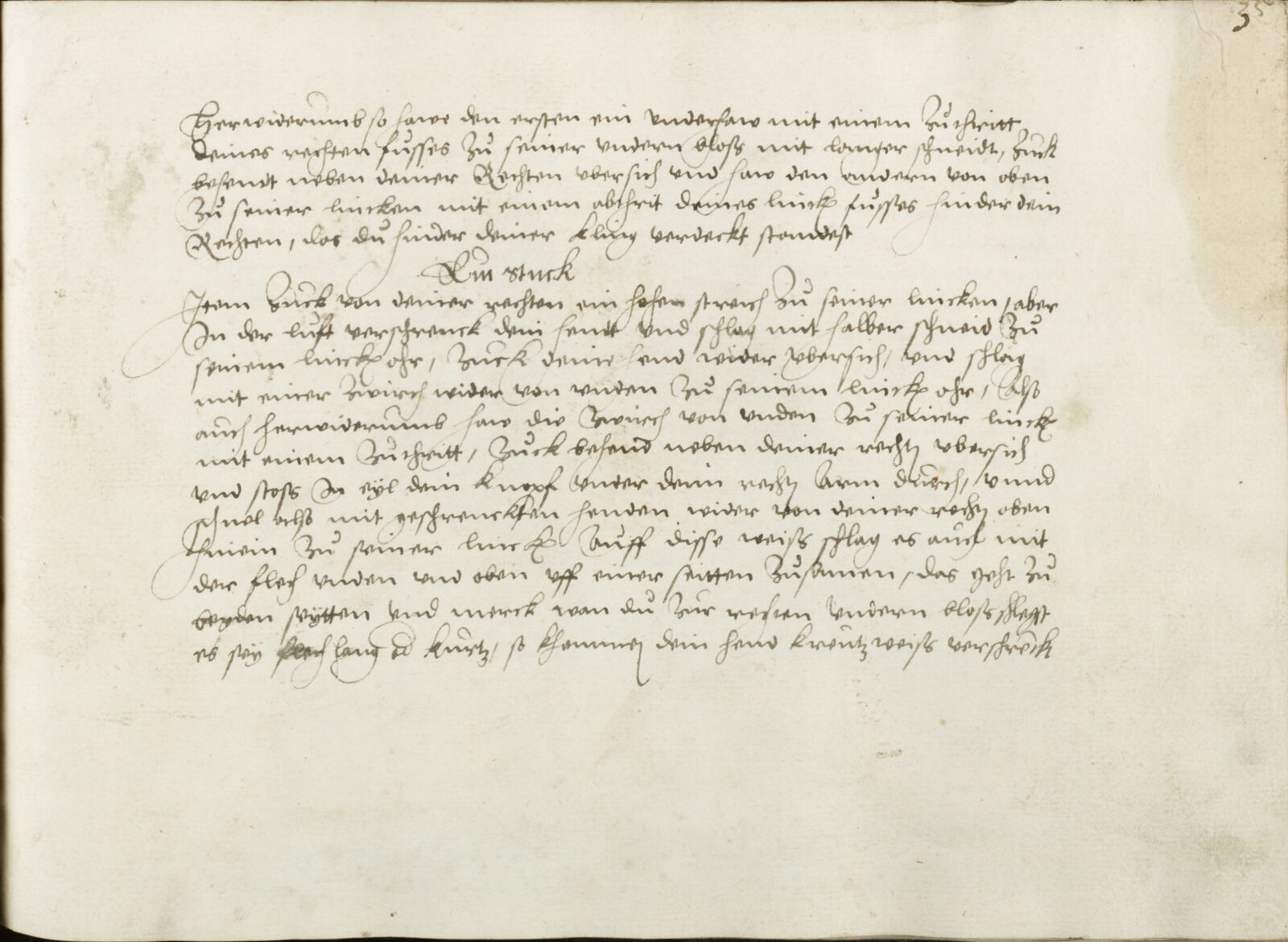
Take heed in the Zufechten of he who pulls up his sword to strike, thus cut through quickly and freely before him how it is taught above, so that you come to his right on to his shield. And as soon as it connects, then wind again with the short edge in at his head, and in this winding, jerk your pommel well upward, so that your blade again snaps around, so that in your cut, your right hand comes back over your left, hit then with crossed hands, and thus in snapping around, wind in below to his right ear, and step at the same time, quickly with your left foot well out to his right. Then at once Thwart to his left ear with a step out, deeply wind your short edge inwards and again outwards to his left ear, and then cut away from him.
Lund Manuscript · fol. 17v.3
[17v.3] Ein frey lauffent stuck auß dem durchschüssen.
Im zufechten hab acht, wan oder in dem er sein schwerdt uff zieht zum streich so haw behend und lustig vor ihm durch, wie oben gelertt, das du uff seiner rechten ahn sein schilt kemmest, so baldt es riret, so winde ihm also die kurtz schneid entwedert zum kopf, und in winden ruck den knopf wol ubersich das die kurzt schneit tief kombt, fert er uff und versetzt, so laß dein kling wider umbschnappen, das dein hend kreutzweiß, die recht uber die lincke khomme, schnel also mit geschrenckten henden, in umbschnappen wind unden hinein zu seim rechten ohr, thrit zu gleich mit dem lincken fuß wol auß uff sein recht in schnell, als bald zwirch mit eim abtrit wider umb zu seim lincken ohr, tief wind ohn seim schwerdt die kurtz schneid einwerts und wider auswerts zu seim lincken ohr, und haw dich von ihm. 
17v.3
2.44linked passage
2.45
[45] Note when he would confuse you with the Crooked, Remain rightly on the sword; carry out the Krieg With winding, slicing, and what’s more; With flitting let yourself not go too far.
In these rhymes you learn how you should hold yourself against one who binds Crooked on your sword, and reports to you, as well, two techniques. Namely the remaining and the War, this is when one binds you Crooked on your sword, thus you should not pull away at once, but remain and feel what kind of work you will need, like for example, if he withdraws you chase after;
Lund Manuscript · fol. 18r.1
[18r.1] Merck so er dich mit krumb wolt ihrn Am schwert recht bleib den krieg thu firn Mit winden, schneiden und was mehr Mit verfligen, laß dich nicht zu fer.
Disser reim lernt dich wie du dich gegen eim der dir krumb ahn dein schwert bind halten solt und meldet zwey stuck dar zu füglich, nemblich die bleiben und den krieg. Das ist wan dir einer an dein schwerdt bindt krump so soltu nicht bald abzucken, sonder bleiben, und alda fullen was dir fur arbeit nöttig, als wan er abging nachreissen.
18r.1
2.45linked passage
2.46
[46] Item If he remains, then you wind. For winding, slicing, wrenching out, and reversing is called the War, through which one to the other always counters the opponent's Stücken. And one counter follows one from another, for if he wards off one, then with this he gives you occasion or helps you to another technique that conveniently follows after it, thus you both make War. Also this same you should note, when an opponent lays on against you with a Crooked Cut, that you shall not fly around from one opening to another, for as soon as you go away from the Crooked Cut, then you are totally open to him, where he will correctly step.
Lund Manuscript · fol. 18r.2
[18r.2] Item so er bleibt winden, dan die winden und schneiden ausreissen verkheren, heist der krig, damit alzeit einer dem andern seine stuck bricht und eins auß dem andern volgt oder hilft, als wan er dir eins wert, damit dich gleich ver uhrsachet oder hilfft zum andern stuck das dem füglich nachvolgt, und also kriegen umb das. Derhalben merck wan dir einer mit krumbhewen zuficht, das du gahr nicht verfligen solt lassen von einer bloß zur andern, dan als baldt du von krump abghst, bistu ihm gantz bloß, wo er in recht thutt.
18r.2
2.46linked passage
2.47
[47] Stuck
If one strikes a Crooked Cut at you from his right, then set off his cut upward with the long edge and when it clashes, then remain with the bind on his blade, wind Indes your pommel up toward his left and the blade down toward his left, the short edge at his left ear, that all this shall occur at the same time as one step. Thus surely you hit, but if he is shrewd and turns the Crooked Cut into the Long point, then wind the short edge with a flick inward at his head, then at once wind through again underneath with the pommel on your left side, thus cast over his blade or arm with the pommel, and wrench out, or whatever the situation will be, then undertake another Stück.
Hawt einer ein krumphaw uff dich von seiner rechten so setz ihm den haw mit langer schneidt ubersich ab, von dir, und in dem es glitscht, so bleib ahn seiner klingen mit dem band winde indes dein knopf ubersich gegen seiner lincken und die klingen undersich gegen seiner lincken, die kurtz schneid an sein linck ohr, das alles sol gleich in eim zugehen, so triffest gewiß, ist er aber so gescheid und verwend den krumphaw in das lang orth, so [19r.1] wind in einem schnal die kurtz schneid inwerts zu seinem kopf als baldt wind mit dem knopf unden wider durch uff dein Linck seitten und greiff mit deim knopf uber sein kling oder arm und reiß auß oder so dir das gewert wirt so nim andere stuck ahn die handt. 
18r.319r.1
2.47linked passage
2.48
[48] Quickly flick the weak to the right, Double flick, protect yourself with the shield.
Note in the Zufechten, come into the right Change; from there, slash up through his face, so that your sword runs around your head above in a loop. Step with your left foot well to his right and strike with the outside flat from your left against his right athwart to his ear, with this, take your head well out of the way how it is previously stated here and when it clashes, then thrust your pommel through under your right arm and wind with the inside flat, in a flick, up from below again to his right ear. In this winding around remain hard on his shield and press hard from you. If he resists then let your sword go away and pull around your head, strike with the outside flat a strong Clashing Cut over your hand Wind through with the pommel back under your arm and flick from inside behind his blade at his head. Remain hard on his shield and wind rapidly back out, thus you stand back in the Clashing Cut as before. Work further as you will to the four openings, such as the need be and is previously taught here.
Lund Manuscript · fol. 19r.2
[19r.2] Baldt schnel die schwech zum rechten dar Zwyfach schnellen mit schilt dich bewahr.
Merck ihm zufechten khum in rechten wechsel von danen streich auff durch sein gesicht das dein schwert uber dem haubt umblauf in einer Rinde, thrit mit deim lincken wol auff sein recht und schlag mit der auswendigen flech von der lincken gegen seiner rechten uberzwerch zum ohr, nhim den kopf wol mitt wie hievor gemalt sthet, in dem es glitscht, so stoß dein knopf under deim rechten arm durch und schnel mit inwendiger flech in von unden auf in einen umbschnal in solchem umbschnal bleib hart ahn seim schilt, und truck hart von dir, helt er wider so laß dein schwerdt leiß auß zuck umb den kopf und schlag mit auswendiger flech zu seiner linck ein starcken glitschhaw uber dein handt, laß dein knopf wider under dem arm durch und schnel von inwendig hinder seiner kling zum kopf, bleib alweg hart ahn seim schilt, und wind in eyl wider herauß, so sthestu wider in glitshaw wie vor. Arbeit weitter was du wilt nach den 4 blössen, wie das zu brauchen sey ist hievor gelert. 
19r.2
2.48linked passage
2.49
[49] Item If one again cuts a High Cut at you from his right then likewise cut a High Cut in against his at the same time. When it clashes, then rapidly thrust your pommel through under your arm and flick back inward to his head, before it rightly connects pull both your arms crossed upwards to your left and wrench upward around on his blade, flick back around at his left ear from below, thus again with the outside flat, how it is presented above, this double flicking shall happen quickly because it is a particularly nimble technique I have thus properly given to you. For when you bind from one side on his sword and remain hard on it and wind at him inwards and outwards in a flick, doubly on one side to the upper and lower part of his head, then when he parries the flicks, you will surely have an opening on the other side that you may connect with a Circle or by flicking around in a single motion.
Lund Manuscript · fol. 19r.3
[19r.3] Item hawt einer ein oberhaw uff dich von seiner recht, so haw auch ein oberhaw gegen ihm zu gleich, in dem es glitscht, so stoß in eyl dein knopf under deim arm durch und schnel zugleich auch einwerts zum kopf, ehe das es recht riret, so zuck dein beidt arm also geschrenckt ubersich gegen deiner lincken und reiß an seiner klingen ubersich umb letzsher handt wider zu seim Lincken ohr von unden und schnel also wider mit auswendiger wie nechst hie oben, diß zweyfach schnellen sol behend zu gehen, und[19v.1] weil es ein sonderlich behend stuck ist, hab ich dirs also eigentlich dargeben, dan gewiß ist wan du von einer seitten ihm ahn sein schwerdt bindest, bleibest hart daran und windest ihm also hinein und auswerts in einen schnell uff einer seitten doppel zu dem ober, under theil seines haubts, so hastu uff der ander seitten (wan er die schnellen versetzt) ein blöß welche du riren magst mit einem zirckel oder umschnall in einem flug.
19r.319v.1
2.49linked passage
2.50
[50] Also wind forcefully against his shield, Instantly shove him away and strike swiftly.
That is when an opponent would defend off your double flicks and sets you off, thus catch his shield with yours and shove out; away from you sideways, Indes let your short edge snap around deep at his other opposite opening.
Lund Manuscript · fol. 19v.2
[19v.2] Auch Jenes schilt starck verwindt Indes abstoß und schlag geschwindt.
Das ist wan dir einer das doppel schnellen wehren wolt, und setzet dir ab, so fasse mit dem schilt den seinen und stoß von dir beseits auß, laß indes die kurtz schneit umbschnappen tieff zu seiner andern bloß gegen uber.
19v.2
2.50linked passage
2.51
[51] If one cuts a powerful Buffel at you, so that you may not come at him with such subtle work, then cut the first at the same time as him and mark now when he pulls his arms back toward him, then drive at him from underneath with horizontal blade on both his arms and in driving under, let go with your left hand from the pommel and grip your blade in the middle, how this figure here after shows. Wrench out besides you both his arms with your shield and cross and as you shove or wrench release your left hand and quickly cut after, either short or long.
Therefore note when a Roof Guard Buffel is coming for you, then see that you parry once or twice, until you see the opportunity; that he has driven up the furthest for a stroke. Then drive his strike away from under on his arms and step well under him, thus he strikes his own arms on your blade.
Lund Manuscript · fol. 19v.3
[19v.3] Hawet einer gewaltig buffel uff dich, das du ihm mit solcher subtilen arbeit nit zu khommen magst, so haw den ersten zugleich mit ein, und merck eben in dem er sein arm wider zu sich zeicht, so fahr ihm mit uberzwercher klingen ahn sein beide arm von unden und in underfaren laß dein lincke hand vom knopf, und begreif dein kling in der mitte, wie disse hernach figur anzeigt, reiß ihm sein beid arm mit dem schilt und kreutz, beseits auß, und in stoß oder riß laß dein linck hand ab, haw behend nach es sey kurtz oder lang. ¶ Derhalben merck wan du also ein tach puffler fur dich bekhumest, so schaw wie du ihm ein streich zwen versetzest, biß du die gelegenheit ersihest, das er in besten aufffaren ist zum streich, so under far ihm den streich uff die arm behendt, thrit wol under ihn so schlecht er sich selber mit den armen in dein kling.,
19v.3
2.51linked passage
2.52
[52] The Squinting Cut you shall do wisely With winding you can also double him.
There are three Squinters, namely two Squinting Cuts; one from the right, the second from your left with crossed hands not unlike the Crooked Cut, how I have reported above concerning the Crooked Cuts. The third is a Squinter with the face, when I focus on a point and act as if I intended to strike there but I do not do this to him, rather I cut in elsewhere.
Lund Manuscript · fol. 21v.1
[21v.1] Den schillhaw soltu weislich machen, Mit winden kanstu ihn auch zweifachen. 
Der schiller sein dreierley nemlich zwen schillhaw einen von der rechten, den andern von der lincken mit geschrenckten henden, dem krumphaw nit uhnenlich, wie oben bey dem krumphaw gemelt, der trit ist ein schiller mit dem gesicht, als do ich ahn ein orth sihe mit sampt den geberden, als wan ich dahnin schlagen wolt, ich thu es aber nicht, sonder schlag anderstwo hinein.
21v.1
2.52linked passage
2.53
[53] The First Squinter goes thus; when you are in the Zufechten, then note as soon as he goes out to strike to your left, then position yourself as if you would strike at the same time to him, do not complete this, but rather turn your sword in the air so that your hand comes crosswise, and then cut in from above to his right with the short edge and crossed arms, at the same time as him, so that his blade comes also to his right, or falls by your right, however, step well with the left foot to his right side.
Lund Manuscript · fol. 21v.2
[21v.2] Den ersten schilhaw treib also, wan du in zufechten bist, so merck als baldt er auff geht zum streich, gegen deiner lincken zu schlagen, so stel dich als wollest zugleich mit ihm einhawen, thu es nicht, sonder verwend dein schwert in der lufft das dein hend kreutweiß khommen und haw mit gekreutzigten armen und halber schneidt zu gleich mit ihm von oben hinein gegen seiner rechten, das sein kling auch gegen seiner rechten khomme, oder neben deiner rechten flech geh, aber thrit wol mit dem lincken fuß uff sein recht seitt. 
21v.2
2.53linked passage
2.54
[54] The Second is the Old Squinting Cut, that goes thus; In the Zufechten send yourself into the right Wrath Guard, if he cuts then at your head from above, thus step from your right and strike to his cut by turning the short edge over his sword in to his head with outstretched arms, how the figures hereafter show.
Lund Manuscript · fol. 21v.3
[21v.3] Den andern das ist der alte schilhaw, den treib also in zufechten schick dich in die recht zornhutt, hawt er dir dhan oben zu dem kopf, so thrit und haw von deiner rechten gegen seinem haw mit verwentter kurtzer schneit uber sein schwerdt zu seinem kopf mit ausgestreckten armen, wie die figur hernach anzeigt.
21v.3
2.54linked passage
2.55
[55] Note When one does a Squinting Cut against your long cut, thus he opens his right side, therefore do not allow him to come onto your sword but rather change through below and cut him to his right long in from your left after driving through.
Lund Manuscript · fol. 22r.1
[22r.1] Merck wan dir einer ein schillhaw gegen denn langen haw thutt so blost er sein recht seitt. Derhalben so laß ihn nicht ahn dein schwerdt khommen sonder wechsel unden durch und haw ihm zu seiner rechten in durchfaren von deiner lincken lang hinein.
22r.1
2.55linked passage
2.56
[56] Item If one changes through under your Squinting Cut to your right side, then remain nevertheless with the point right before his face and turn the long edge against his blade, allow Indes your pommel to go through under your right arm and step with your left foot well to his right side. Thus he has changed through in vain, for you come at his head with the first Squinting Cut and crossed hands. At once allow it to run off by his right side using the Circle and Thwart to his left.
Lund Manuscript · fol. 22r.2
[22r.2] Item wechselt dir einer under deim schilhaw durch zu deiner rechten seitten. So bleib gleichwol mit dem orth gerichts vor seim gesicht, und wendt die lang schneid gegen seim schwert laß indes dein knopf under dem rechten arm durch gehen, und schritt mit dem lincken fuß wol uff sein recht seitten, so hatt er vergebens durch gewechslet, dan du kommest in mit dem ersten schilhaw mit geschrenckten henden auff dem kopf, laß als baldt durch den zurckel neben seim rechten ablauffen und zwirch zu seiner lincken. 
22r.2
2.56linked passage
2.57
[57] Counter to the Plow
Note when an opponent comes before you in the guard of the Plow, then attack happily with the Squinting Cut. As soon as he drives out, then work to his lower openings and further to all four openings.
Merck dir einer fur kompt in der hutt des pflugs, so greif frolich an mit dem schülhaw, so baldt er auff fert, so arbeitt ihm zu den unden blossen, und furtter zu allen vier enden.
22r.3
2.57linked passage
2.58
[58] Counter to the Long Point
Item: If one stands before you in the Long Point, thus position yourself with the gesture that you would cut in with a long High Cut to his left ear, do not do this, but rather turn in the air and cut a strong Squinting Cut to his sword, when it clashes, then slice the point forward into his face so that he must displace. When he drives upwards then pull your sword around your head in a flight and cut with the short edge and crossed hands; athwart to his right ear, allow the left hand to go well out and thus the short edge goes deep. Pull again around your head and wrench out his blade with the flat from your right athwart to his left, so that your sword again flies around above your head and allow the short edge to shoot in deep to his left ear, at once cut two Low Cuts to his right and left, Indes cut away.
Item sthet einer vor dir in langen orth, so stell dich mit geberden, alß du ein langen oberhaw woltest zu seinem lincken ohr hawen, thu es nit sonder verwend in der lufft und haw ein starck schilhaw uff sein schwerdt in dem es glitscht, so scheüb den orth fur dir hin zu seim gesicht[23r.1] das muß er versetzen in dem er ubersich fehrt so zuck dein schwerdt in einem flug umb den kopf haw mit gekreutzigten henden die kurtz schneid uberzwer zu seinem rechten ohr, laß die linck handt wol uff gehen, so geht die kurtz schneid tieff, zuck wider umb den kopf, und reiß ihm sein kling von deiner rechten uberzwerch zu seiner lincken mit der flech auß, das dein schwert uber deinem haubt wider umbfligt, und laß ihm die kurtz schneidt tieff einschiessen zu seinem linck ohr, als bald haw zwen underhaw zu seiner rechten und lincken, indes haw dich wegk. 
22r.423r.1
2.58linked passage
2.59
[59] Item: If an opponent comes before you who will gladly bind long on to you from above or sends his first stroke long at you from the Roof, then when you are near to him or have come to him, slash through before him, up and out to your left, so that your sword's blade shoots around over your head in the Plunge to his left, Indes allow your sword to snap around back over your head, the right hand over the left and strike in at his right ear with the short edge at the same time as his strike, how it is taught above, do this correctly and step well there to him thus you will hit. So then this Stück is only on going, if he displaces however and drives out how he then (when he will displace) must drive out, at once pull around your head and cut him with the long edge from below athwart to his left radial forearm, close to his pommel to the wrist. Of these two openings, one will be apparent to you. Pull your hilt again upwards around your head and cut long with a strong cut to his upper left head, in these three strikes, step well with both your feet, in a double, step around his left side, thus the cuts go on well, this a good and earnest Stück, when you will seek to send it home.
Lund Manuscript · fol. 23r.2
[23r.2] Item kompt dir einer fur: der gern von oben lang auff dich bindet oder sein ersten streich lang von tach uff dich thut, wan du dan nahet bey ihm bist, oder zu ihm kommest, so streich vor in durch, uberstich auff gegen deiner lincken: das dein schwerdts kling in sturtz uber deinem haubt umschiesse, gegen seiner lincken, indes laß dein schwerdt uber deinem haubt wider umschnappen, die recht handt uber die linck, und schlag also mit kurtzer schneidt zugleich mit seinem streich hinein zu seinem rechten ohr, wie oben gelert, machestu das recht, und thritst wol darzu, so triffestu gewiß, dan das stuck ist mir offt angangen, versetzt ers aber und fehrt auff wie er dan (so ers versetzen wil) muß uff fahren, als baldt zuck umb den kopf und haw ihm mit langer schneidt von unden uberzwerch zu seiner lincken spindel, nahet under dem knopf hinein zum knichel, under diessen zwo blossen wirt dir eine werden zuck dein gefeß wider ubersich umb dein[23v.1] kopf und haw ein starcken langen haw zu seiner lincken uber sein kopf in diessem dritten streich thrit wol mit dein beiden fiessen in ein zwifachen thrit umb sein linck seitten so geht der haw wol ahn das ist ein guth ernst stuck, so du ein doheim suchen wilt.
23r.223v.1
2.59linked passage
2.60
[60] Another Stück from the Squinting Cut
In Zufechten, when you come close to him, then position yourself as if you would cut a long High Cut at him, when he drives out to meet you, thus turn the short edge from your right, in the air, against his left and jerk your pommel upwards, cut him with the short edge over his arm or hand, step well to his left side, allow this to run forth over in a circle and cut long after to the next opening, or fight to him with the Low Cuts.
Im zufechten wan du schier bey ihn kommest, so stel dich als wollest ein langen oberhaw thun in dem er auff fehrt dir zubegegnen, so verwende in der luft die kurtz schneid von deiner rechten gegen seiner lincken, und ruck dein knopf ubersich, schlag ihn mit der kurtzen schneid uber sein arm oder hend, thrit wol auff sein linck seitten laß also in einem zurckel fur uber lauffen und haw lang nach zur nechsten bloß, oder ficht auß den underhewen zu ihm.
23v.2
2.60linked passage
2.61
[61] The Double Squinter
Item: At the Start, thus cut against his cut from your right, with a Squinter to his sword, when this clashes, then reverse your sword on his blade and slide off to your left, step out with the right, continuing towards his left side, allow your blade to drive around your head and cut the next Squinter to his head, also from your right above and in deep to his left. Then cut a Double Squinter, nimbly, one into the other, stepping to his left, this is a very swift Stück against slow fencers who fight with their arms far from themselves.
Item in anthrit so haw gegen seim haw ein schillhaw uff sein schwerdt von deiner rechten in dem es glitscht, so verkher dein schwerdt ahn seiner klingen und rutsch also uff seiner klingen gegen deiner lincken seitten auß thrit mit dem rechten furbaß gegen seiner lincken laß dein kling umb den kopf faren und haw den anderen schilhaw zu seinem kopf auch von deiner rechten tieff oben hinein zu seiner lincken, also das du zwen schilhaw einen wie den andern behendt uff einander schlegst mit einem zwifachen thritt gegen seiner lincken, das ist ein geschwindt stuck uff die langsamen fechten die die armen weit von sich fieren.
23v.3
2.61linked passage
2.62
[62] The Third Squinter is a deceiving with the face
In Zufechten slash up so that you come into the guard of the Roof, as soon as you can reach him, at once wind the short edge to him, while its still in the air, squint with your face as if you would cut to his left with the Squinting Cut, don't do this, but rather allow the Squinter to fall past by his left and work to his right, or work him to the right and cut quickly again to his left, take your body well after with it, for this is a fine and good work that can't be written as well as it can be shown with the living body.
Lund Manuscript · fol. 24r.1
[24r.1] Der dritt schiller ist ein verfirung mit dem gesicht
Im zufechten khom ihm auff streichen in die hutt des tags so bald du ihn erlangen magst als baldt wend die kurtz schneid nach also in der lufft gegen ihm, sthell dich mit dem gesicht als wollest mit dem schilhaw zu seiner linck einhawen, thu es nicht, sonder laß den schiller fhel sein und fur seiner lincken also fur uber lauffen und arbeit ihm zu seiner rechten oder winck ihm zu der rechten, und schlag behend wider zu seiner linck, nim den leib wol mit, es ist schöne und gutte arbeit, die sich nicht last schreiben als mit lebendigem leib zeigen. 
24r.1
2.62linked passage
2.63
[63] Note a swift Stück from the Squinter
When you come close to him, then Wing up by him, so that you come with crossed hands into the Unicorn. In this Winging up, lift your left foot somewhat upwards, after you come through the Unicorn with crossed hands, thus you stand as if you would shoot through, as soon as he extends his sword out, thus cut then with crossed hands and the short edge from above again to his right, on to the forward portion of his sword's blade and before it connects, turn your short edge around and cut with the Squinter, that is with the short edge from your right to his left side, to his arm or face, not with crossed hands and with a step of your right foot, towards his left, in hitting, allow your blade to run off from his left only slightly besides and along with this, thrust through at once with your pommel, under your right arm, then cross your hands so that your short edge snaps around again to his left, over to his head or arm thus with crossed hand from your right to your left or bar him over both of his arms, if he holds you again so that you cannot wrench out or suppress from above, then allow the pommel to run through below and grab him over his right arm, drive the wrestling to him.
Lund Manuscript · fol. 24r.2
[24r.2] Merck ein geschwind stuck auß dem schiller. 
In dem du schier zu ihm komest, so flugell fur ihm auff das du mit geschrenckten henden in das einhorn khommest, in auff fluglen erheb dein lincken fuß etwas ubersich, dem gewicht nach, das du mit geschrenckten henden hoch durch das einhorn khommest, so sthestu als wollest durch schiessen, alß bald er sein schwert ausstreckt, so haw also mit geschrenckten henden und kurtzer schneiden von oben nider gegen seiner rechten biß ahn das eysertheil seiner schwerts kling und ehe es riret wend dein kurtz schneidt umb, und schlag mit dem schilhaw, das ist mit kurtzer schneidt von deiner recht nicht mit geschrenckten henden zu seiner lincken seitten als arm und gesicht, mit einem zutrit deines rechten fusses, gegen seiner lincken, in treffen laß dein kling von seiner lincken ein wenig beseits auß lauffen, und stoß gleich mit auch dein knopf under deim rechten arm durch, verschrenck also dein hendt, das dein halb schneidt wider umbschnap gegen seiner lincken uber sein kopf oder arm, reiß [24v.1] also mit geschrenckten henden von deiner rechten gegen deiner lincken sein schwert auß, oder schrenck ihm uber sein beid arm, helt er wider das du nicht ausreissen noch uberschrencken kanst, so laß unden durch lauffen mit dem knopf, und greif ihm uber sein rechten arm, treib die ringen gegen ihm.
24r.224v.1
2.63linked passage
2.64
[64] From Changing Through.
Changing through is useful against those who fight with the Squinter or Crooked Cuts. Note this also, if he does not extend his hands far from him in his cuts but rather holds them close by himself in fighting, you may readily change through far from him.
Durchwechslen gehort uff die so also mit schiller oder krumphewen fechten das merck also, reckt er sein hend nit lang von ihm in seinen hewen, sonder beheldt die in fechten nah bey sich, dem magstu frolich durchwechslen in der weitte.
24v.2
2.64linked passage
2.65
[65] Item If he fights with winding, reversing, Crooked Cuts, Squinting Cuts or any other Stück with it he shortens his strike or cannot fight long from himself, how it then goes in such Stücken in which you shall also (before they bring their technique to the halfway) change through against him, to the other side which he opens with this shortening, thus you force him to displace and he allows the Before to pass to you.
Lund Manuscript · fol. 24v.3
[24v.3] Item ficht er auß dem winden verkeren, krumphew, schilhewen, und was der stuck mehr sein, damit er sein schwerdt verkurtzt, oder nit lang von sich khan fechten, wie es dan in solchen stucken geschicht, denen soltu auch durchwechslen (ehe dan sie ihr stuck zum halben end bringen) zur andern seitten welche er mit solchem verkurtzen blöst, damit zwingstu ihn zu versetzen und dir das vor zulassen.
24v.3
2.65linked passage
2.66
[66] Item If one fights far and long from himself with the long edge, however more to your sword than body, then you shall change through to the next opening and allow him to fall through with his cuts. So then be diligent with how you fence, that is with the short or long edge, that you namely cut him to the opening, that is, you cut him to the body and if it does not always happen that you may cut him to the body, thus when he changes through, you quickly fall in after his sword to the opening.
Also thus note this Rule in all cutting, when you connect or catch his blade with your strong, in the bind, as soon as it clashes, you shall cut at once with the weak (that is with the forward part) to the body or next opening cut at, so that then your sword cuts likewise at his blade and body, or as soon as your strong connects with his sword, then as they clash together you shall turn the weak to the nearest opening with flicking, snapping and winding.
Lund Manuscript · fol. 24v.4
[24v.4] Item ob schon einer weit und lang von sich ficht mit langer schneidt, aber doch mehr zu dem schwerdt dan leib, dem soltu durchwechslen zur nechsten bloß und ihn mit sein hewen verfelen lassen. Derhalben so vleiß dich was du fichts es sey mit kurtzer oder langer schneidt das du ihm furnemlich zur bloß das ist leib hawest, und ob es schon nit alweg khan sein das du ihm zum leib hawen magst, so soltu doch, so baldt er durchwechslet seinem schwerdt nach zur bloß einfallen. Auch so merck diesse Regel in allen hewen, so du mit der sterck sein kling rirst oder entpfahest in bandt, als bald und gleich mit in dem es noch glitscht soltu zugleich auch mit der schwech (das ist mit dem eyssern theil zum leib oder[25v.1] nechsten blöß einhawen das also dein schwerdt sein kling und leib zugleich trifft, oder so baldt dein sterck sein schwerdt riret in zusamen glitschen, die schwech zur nechsten bloß wenden mit schnellen, schnappen und winden
24v.425v.1
2.66linked passage
2.67
[67] Further you should take from these lessons, when you will execute these techniques against someone who knows how to change through against you, for example when you send your sword into the air for a Squinting Cut or Crooked Cut.
Lund Manuscript · fol. 25v.2
[25v.2] Ferner halt dich auch uff disse lehr wan du solche stuck fechten wilt gegen denen, er dir durchwechslen khan, Als nhemlich dieweil du dein schwerdt in der lufft firest zu einem schilhaw oder krumphaw.
25v.2
2.67linked passage
2.68
[68] Item To the Crossing over, Falling, and others which are similar, as soon as you realize that he will change through, then fall from such work into the Long Slice, to the opening that he gives you by changing through. For often when he changes through he opens himself. And when you travel after to his opening, then watch for his sword with the long edge, if it would come too near to you, that you turn the strong against him and at the same time, remain on his opening with the short edge, as soon as you have connected, then remain no longer but rather let it quickly fly away from one opening to another.
Lund Manuscript · fol. 25v.3
[25v.3] Item zuverschrencken verfellen was dergleichen ist, so bald du gewar wirst das er durchwechslen wil, so verfal auß solcher arbeit in langen schnidt der blöse zu die er dir geben wirdt in durchwechslen, dan so offt er durchwechslet blöst er sich, und in dem du ihm zur bloß nachreisest, so wart mit der langen schneiden seines schwerts, wo er dir zu nah wolt khommen, das du mit der sterck gegen ihn wendest, und gleichwol mit der kurtzen schneiden uff seiner bloß bleibest, als bald du geriret hast, so verhar nit lenger, sonder laß abfligen, von einer bloß zur andern.
25v.3
2.68linked passage
2.69
[69] The Thwart you shall also consider valuable, With it your skill in the sword becomes great.
The Thwart is one of the chief master techniques with the sword. For you should know, if the Thwart did not exist, then it would be like "half fencing", especially when you are under the opponent’s sword and therein you can no longer attack with long cuts through the Cross, and if I have already written enough about the Thwart such that if someone knows how to fight, he could have a sufficient understanding from it, but meanwhile I write not great of great Fencers or Artists, also I have not intended to write historically of fencing, as the art is drawn from memory. But rather solely, I've attempted to write an instruction book, therefore I will not only repeat the Thwart here, but also write more fully about it, for the instruction of those that love such art.
Lund Manuscript · fol. 25v.4
[25v.4] Die zwirch soltu auch halten werdt Damit gantz wirdt dein kunst in schwerdt
Die zwirch ist auch der furnemen meister stuck eins in schwerdt, dan du solt wissen wan die zwirch nicht wehr, wehr es umb das halb fechten geschehen, sonderlich wan du under des manß schwerdt drinen bist, do du nicht mehr mit langen hewen durchs kreutz fechten kanst, ob ich schon fornen auch von der zwirch geschrieben, so viel, das wo einer fechten kan genugsam verstandt darauß kunde, aber dieweil ich nicht grossen [26r.1] fechtern oder khunstlern schreib, auch mir nit furgenomen hab historischer weis von fechten zuschreiben, als die khunst denckwurttig auff zu zeichen, sonder allein ein lehrbuch zu schreiben furgenomen, derohalben ich die zwirch hie nit allein wider ereffern, sonder auch weitleuffiger daruon zuschreiben, zur lehr denen die solche khunst lieben.
25v.426r.1
2.69linked passage
2.70
[70] In Zufechten take note if your opponent will attack at you from the Day, (that is from above) then slash up from the right Change toward your opponent's face, when he will strike or cut, then let your blade drive towards your left and around your head, so that your flat stands upward and your thumb is underneath on your shield, step with your right foot well around his left side toward him, simultaneous with the step, cut with the short edge from your right to his left ear, so that together your hilt and with the thumb underneath, stands high above your head to the displacing, so then if he strikes, you will catch his stroke on the strong of your sword and at the same time with the forward short, you cut athwart from below to his left ear, how the second figure shows, as soon as the swords connect together or clash, then strike with the long Thwart deep at his right ear, such that your thumb remains underneath, perpendicular.
Lund Manuscript · fol. 26r.2
[26r.2] Im zufechtern hab acht, ob der man uff dich vom tag (das ist von oben) angreiffen will, so streich von dem rechten wechsel uff gegen des mans gesicht in dem er schlagen oder hawen will, so laß dein kling neben deiner lincken umb den kopf faren, das dein flech uber sich sthe, und dein daumen undersich uff deinem schilt, thrit mit dem rechten fuß wol umb sein linck seitten zu ihm, gleich mit dem thrit haw mit halber schneid von deiner rechten gegen seinem lincken ohr, das dein gehiltz und sampt dem daumen unden hoch uber dem sthe zur versatzung, ahn das er schluge, du ihm sein streich uff die stercke deines schwerdts entpfangest, und zu gleich mit der eyssern kurtz zwerchs von unden zu seinem linck ohr hawest, wie die zweit figur ausweist, so baldt die schwertter zusamen riren oder glitschen, so schlag mit der langen zwirch das dein daum unden bleib uber eck zu seim rechten ohr tieff,
26r.2
2.70linked passage
2.71
[71] Secondly, note when you strike in with a Thwart at the same time as him, or bind on, then from this same, at once search above and below for the openings, with reversing, snapping around again, or Thwarts, fearless Traveling after, then as soon as One will cut from above at you, thus displace him with the Thwart, so that with this, the swords clash together, then reverse, set off upwards, seek the openings and fight with the types of works that have been reported here previously. Wherein Liechtenauer speaks correctly in his cryptic verses,
The Thwart takes All that come from above, Thwart with the strong Mark your work with it.
that is; all high strikes, displace with the Thwart, or how I have here set forth with my Rhymes:
Lund Manuscript · fol. 26r.3
[26r.3] zum andern merck wan du mit eim zwirch schlag zugleich mit ihm einhawest oder anbindest, so bald such oben und unden uff der selben die blöß mit verkheren und widerumb schnappen oder zwirchen, uberschrencken nachreissen, dan als bald dir einer von oben zuhawet, so versetz ihm mit der zwirch in dem die schwertter zusamen glitschen so verkehr, schrenck uber such die blöß, und ficht was dir fur arbeit hieroben gemeldt wirt, darumb[26v.1] spricht Lichtenawer recht in sein verborgennen reimen zwir benimbt was von oben kümbt, zwirch mit der sterck dein arbeit damit merck das ist alle tach streich versetze mit der zwirch oder wie ich sie hie in meinen reimen gesetzt.
26r.326v.1
2.71linked passage
2.72
[72] For everything that comes from the Roof The Thwart may displace this In the Onset drive the Thwart strongly Note also you Reverse and Fail with it.
If one cuts at you from above, thus Thwart strongly against his strike, you force him to fall so much lower with his cut, when it connects you must then thrust your pommel through under your right, reverse, press downwards, let the blade snap around again with the short edge in his face, yet such that in the reversing and snapping around you remain with the slice on his arms.
Lund Manuscript · fol. 26v.2
[26v.2] Dan alles was do kompt vom tag Die zwirch solches versetzen mag Im angrüff treib die zwirch mit sterck Verkeren felen auch mit merck.
Hawet einer von tach so zwirch gegen seim streich mit sterck damit zwingstu ihn das er desto tieffer mit seinem haw zu thal fallen muß in dem es glitscht, so stoß dein knopf under deim rechten armen durch und verkher, druck undersich und laß die kling wider umbschnappen die kurtz schneid in sein gesicht, doch das du in verkheren und umschnappen mit dem schnidt uff sein armen bleibst,
26v.2
2.72linked passage
2.73
[73] This Stuck goes well when you do it quickly. However, if he escapes you upward too quickly with his arms, then allow your blade drive around your head, so that your long edge comes forward on his arms, athwart through with a Low Cut, how the figure here after shows, however do not let go with your left hand from the hilt, rather thrust him from you with crossed hands.
Lund Manuscript · fol. 26v.3
[26v.3] das stuck geht wol ahn wan du es in einer geschwinde machest, wuscht er dir aber mit den armen zubehend ubersich, laß dein kling umbfaren umb dein kopf das dein lang schneid fornen ahn sein arm khum, uberzwerch durch ein underhaw, wie die figur hernach außweist, aber laß die linck handt nit vom hefft sonder stoß in von dir mit geschrenckten henden.
26v.3
2.73linked passage
2.74
[74] To Plow and Ox you are quick Threaten the cut at once against the target.
This verse is very clear, how the others also are, namely that you should quickly cut the Thwart to the Ox and Plow, to the lower and upper opening, to the left and right, nimbly crosswise, diagonally opposite to all four parts, how with other names, thus you will see the four openings, further reported hereafter, extensively.
Lund Manuscript · fol. 26v.4
[26v.4] Zum pflug und Ochsen biß behend Im draw den haw bald wider end
Der reim ist an ihm selbst gahr deutlich, wie auch die andern. Nemlich das du zu dem pflug und ochsen, das ist, zur undern und obern blöß zu linck und recht behendiglich kreutzweiß und ubereck zwirchen solt zu allen vier theilen wie mit andern hewen so in den 4 blössen hernach weitter gemeldt wirt und weittleuffliger. 
26v.4
2.74linked passage
2.75
[75] Next you will learn from the rhyme, how with the High Cuts you shall deceive, thus you step forth, then position yourself with comportment and cut a powerful Thwart to his left, if he would go against your sword, whether from above or below, do not allow it to connect, but pull away again and Thwart Cut to his right, against his head, you may also threaten him with the Thwart to his lower left, then Thwart from above.
Lund Manuscript · fol. 27r.1
[27r.1] Zum andern lertt dich der reim, wie du mit der zwirch es sey von oben oder sonst verfiren. Also in antrit so stell dich mit geberden, und haw ein gewaltigen zwirchaw zu seiner lincken, wüscht er mit seinem schwerdt gegen deiner zwirch es sey von oben oder unden, so laß nit riren, sonder zuck wider ab und zwirch zu seiner rechten gegen uber tieff, also magstu ihm die zwirch zur lincken unden drauen, und zur rechten ober treffen
27r.1
2.75linked passage
2.76
[76] Item Threaten to the lower right, and cut to the lower left with this Thwart, thus you can also note that then when you go at his left with the Thwart, then at once to the right threaten but strike back to the left, where you firstly intended, from this knowledge you can pull the Thwart to both sides, crosswise and diagonally opposite. Threaten, then strike after your advantage how it pleases you and in the rough Zufechten there is no cut as safe as the Thwart.
Lund Manuscript · fol. 27r.2
[27r.2] Item zu rechten unden trauen und zur lincken unden treffen mit dieffer zwirch, also kanstu auch doppel verzucken, als wan du in zu lincker mit der zwirch als bald zur rechten drawest und triffest doch mit der zwürch zur lincken do du erstlich getrawet hast. Auff disse weiß kanstu zu beiden seitten kreitzweiß und ubereck, die zwirch verzucken, trauen und treffen noch gelegenheit nach gefallen, und ist auß keinem haw so sicher in gemein zufechten als auß der zwirch. 
27r.2
2.76linked passage
2.77
[77] Note when the Thwart is executed with a spring, And you execute failing with it, it connects at your will.
Note in the Onset when you will deliver a Thwart to the upper left opening, then spring well out with it and also let your pommel go well upward, thus the Thwart goes deep at his head, especially when you disguise the gesture, you can also when he likewise does not perceive the spring until it has happened, and the Thwart has hit, but if he sees it and defends or parries you, then you shall cut to the lower and opposite corner.
Lund Manuscript · fol. 27r.3
[27r.3] Merck was fur zwirch mit spring wirdt gfiert Auch feler mit, noch wuntschen riret
Merck in zufechten wan du zur lincken obern blöß zwirchen wilt, so spring wol auff darzu, und laß auch den kopf wol ubersich gehen, so geht die zwirch tief zum kopf, sonderlich wan du die geberdt also verstellen kanst auch gleich uhnversehens mit der zwirch doher springst, das er des sprungs nicht wahr nimbt, biß es geschehen und die zwirch getroffen hatt, sihet ers aber und whert oder versetzt dir, so hastu in unden uber eck gewiß.
27r.3
2.77linked passage
2.78
[78] Item When you thus strike with the Thwart high at your opponent with a spring, and however you do not let it hit, but rather fail and run off beside his left and you strike in rapidly with the Thwart at another opening, then you will hit at your will. For before he thinks to parry the Thwart, you have hit elsewhere.
Lund Manuscript · fol. 27r.4
[27r.4] Item wan du dem man also in eim sprung hoch zuschlegst, mit der zwirch und last es aber nicht treffen, sonder neben seiner lincken fhel lauffen, schlechst alß in eyl mit der zwirch einer andern blöß zu so trifestu nach wunsch, dan eh er sich besint zu versetzen, so hastu anderst wo troffen. 
27r.4
2.78linked passage
2.79
[79] Double shall your Failer be done Likewise double the step and slice.
The Failer is a good technique against the fencers who will gladly displace like in the previous Stück concerning the Thwart, then when you cut to an opening and note that he wishes to parry after, then allow your cut to fail and go by, and cut diagonal to another opening. Double failing is an artful technique and requires an experienced fighter as well, however I will present and describe here to you several double and single techniques from which you can learn many kinds of Failers.
Lund Manuscript · fol. 27v.1
[27v.1] Doppel solt den feler machen Dergleichen thrit und schnidt zweifachen
Der feler ist ein guth stuck gegen die fechter die gern versetzen, als wan du einer bloß zu hawest, und merckest das er dem haw nach wuscht zu versetzen so lastu den haw fehl abgehn, und schlest einer andern bloß zu. Doppell fellen ist ein kunstreich stuck, und gehert ein geubter fechter darzu, aber ich wil dir etliche stuck darauß du villerley feller wol lernen kanst setzen.
27v.1
2.79linked passage
2.80
[80] Item In the Zufechten send yourself into the Wrath Guard to the right, as soon as he brings his sword in the air, then cut from your right with the long edge to his right side, by going over your head and with outstretched arms, but fail and drive the Thwart to his left, do not allow that to connect but rather go around the head again and cut with the long edge so that you swing in with the Flat to his right ear, now reverse, snap around and allow it to fly.
Lund Manuscript · fol. 27v.2
[27v.2] Item in zufechten schick dich in die zornhutt zur rechten, als baldt er sein schwert in die luft bringt, so haw von deiner rechten umb den kopf mit langer schneit und ausgestreckten armen zu seiner rechten seitten fehl, und traw ihm die zwirch zur lincken laß nicht riren, sonder wider umb den kopf und haw mit langer schneid das sich die flech dapfer einschwing zu seim rechten ohr, itzt verkher schnap umb laß verfligen. 
27v.2
2.80linked passage
2.81
[81] Item In the Zufechten cut a long High Cut to his upper left opening when you in the Zufechten, cut a long High Cut at his upper left opening, when you have almost connected with his blade above in the air with the cut, then change this High Cut into a Thwart, and strike him with the Thwart from below at his left ear or arm, that goes to both sides.
Lund Manuscript · fol. 27v.3
[27v.3] Item in zu fechten haw ein langen oberhaw zu seiner lincken obern blöß wan du mit dem haw oben in der luft schier an sein kling rirest, so verwandle den oberhaw in ein zwirch und schlag ihn mit der zwirch von unden zu seinem lincken ohr oder armen, das geht zu beiden seitten.
27v.3
2.81linked passage
2.82
[82] A Failer with the False step
In the Zufechten deliver a lofty High Cut and when your blade almost connects with his blade, at once change the High Cut into a Thwart and at the same time as the Thwart step through to the side with your right foot, between you and him to his right side, at once allow your sword to snap around again and strike him with the short edge to his right ear so that your hands are crosswise, or cut after with the long edge and spring well out to his right side with this strike.
Item in zufechten thu ein hohen oberhaw und wan dein kling schier in sein kling riret, so bald verwendel den oberhaw in ein zwirch und gleich mit der zwirch thrit, thrit mit dem rechten fuß zwischen dir und ihm beseits auß durch uff sein recht seitten, laß bald wider umbschnappen, und schlag ihn mit kurtzer schneid zu seim rechten ohr, das dein hend in streich kreitzweiß seindt oder haw mit langer schneid nach und spring ihm streich wol uff sein recht, beseits auß.
27v.4
2.82linked passage
2.83
[83] Twice or Double failing
Item In the Zufechten, before you correctly come to him, thus cut through besides your right, so that your weapon shoots over in plunging, step on your way, with the right foot to him, let your sword drive around the head and pull a high strike from the Roof while in the air, but cross your hands, threaten to cut with the short edge, if he whisks this from him and will set on, thus wind you hand around again and convert your Crooked edge into a Thwart, let the Thwart also not proceed, but rather fail and run past, then strike the other, to his right side, that is double failing, these two Failers will be accomplished in the air when you wind around his blade, yet you can terminate this therein when you will, to the displacing or in a winding, thus when he would reach to you, that you with your Stück would not like to come to him, but when you have deceived him, that he feels he must displace you, thus is the Double Failer very good and goes very quickly.
Item in zufechten ehe du recht zu ihm kommest, so haw neben deiner rechten durch das dein wehr uberschies in sturtz, thrit furbaß mit dem rechten fuß zu in laß dein schwerdt umb den kopf faren und zuck ein hohen streich von tach in der lufft verschrenck deine hend, draw ihm ihm (sic) mit der kurtzen schneiden zu schlagen, wuscht er ihm nach, und wil versetzen, so wend dein hend wider umb und verwandle die kremp schneid in ein zwirch laß die zwirch auch nicht riren, sonder fehl furuber lauffen, und schlag zur andern seiner rechten seitten, das heist doppel gefehlt, geht gleich in einem winden zu, kanst abbrechen darin wan du wilt zur versatzung, oder in ein schnid verwenden, so er dich dringen wurde, das du mit dem stuck nicht zu khommen mochtest. Wan du ihn aber darzu getrungen hast, das er dir versetzen muß, so ist der doppel feller sehr guth, und geht gahr geschwind zu.
28v.1
2.83linked passage
2.84
[84] Item This is also called the Double Failer when you let it double or twice run off, to deceive him.
Lund Manuscript · fol. 28v.2
[28v.2] Item das heist auch doppelfellen, wan einer doppel oder zweymol last ablauffen den man zu verfiren.
28v.2
2.84linked passage
2.85
[85] Another from the double Failer
In the Zufechten bring a high strike from your right and in the air, before it connects, thus wind the short edge against him, as if you would cut the Squinting Cut, but don’t let the short edge connect either, but rather quickly fail and run off, and swing in to him with your weak, to his right ear with crossed arms, let it quickly fly around again, and fall on him with the slice to the next opening, or on his sword, from there to the body and on the arm.
Im zufechten bring ein hohen streich von deiner rechten und in der luft ehe dan es riret, so verwende die kurtz schneid gegen ihm alß du den schilhaw wollest thun, laß aber die kurtz schneid auch nicht riren, sonder behend fehl ablauffen und schwing ihm die schwech zu seinem rechten ohr, mit gekreutzigten armen laß behend wider abfligen, und fal ihm mit dem schnidt zur nechsten blößoder ahn sein schwerdt, von danen zum leib oder uff die arm. 
28v.3
2.85linked passage
2.86
[86] Counter to the Thwart
Mark when you have bound with one from above, or, at the same time, cut in with him, thus see if he would with the Thwart strike around, [and] thus come before with the Thwart under his blade, on his neck.
Merck wan du mit einem von oben bindest oder gleich mit ihm einhawest so sihe ob er mit der zwürch wolle umbschlagen, in dem er umbschlegt, so khomme [29r.1] vor mit der zwirch under seiner klingen ahn sein hals
28v.429r.1
2.86linked passage
2.87
[87] Item: If he Thwarts from under, so that you can't come from below thus catch his Thwart on your shield with diverting, so that your blade hangs over his.
Lund Manuscript · fol. 29r.2
[29r.2] Item zwircht er von unden das du nit darunder khommen khanst, so fang sein zwirch mit furschuben ahn dein schilt, das dein kling uber seine uberhengt
29r.2
2.87linked passage
2.88
[88] From Stepping
In stepping is much concerned. Therefore, see that you give stepping to him with every one of the cuts, then when you cut to his openings and you don't step with the foot from which side you have cut, thus is the cut useless, but when you don't dare to give all to the cut, thus may you also not step fully, rather only with the gestures stand, when you do step, such you will better learn still, with practice.
Twice stepping is done like this, when you are stepping with your right to his left, this necessitates then that you still farther step around, thus step quickly with the left foot towards the right, behind your right foot beyond or past, before you have even set your left, you can step forth with the right, then Slice double, mark this following Stück:
If one cuts at you from his right, thus cut also from your right simultaneously, with the short edge and crossed hands, so that in this, the sword proceeds, thus step in with a double step with the right foot, quickly around to his left, and fall with your long edge on his arm, now set above, and if he drives upwards, and will not trouble you with the slice, thus follow after with an under slice on his arm, shove him from you how the figure nearby demonstrates, that is a proper and Old Cut and cuts down a Master with it.
Am thretten ist viel geegen, darumb schaw das du einem jeden haw seinen thritt gebest, den wan du ihm zu der bloß hawest, und thritest nicht mit dem fuß von welcher seitten du gehawen hast, so ist der haw kein nütz, wan du aber den haw nich gantz sonder drauest zuhawen, so darffest auch nicht gantz thretten, sonder nhur mit geberden stellen, als threttestu, doch wirt dich solches die ubung besser lernen, zweyfache thritt mach also wan du mit dem rechten zu seiner lincken tretten bist, erfordert dan dein stuck das du noch ferner herumb threttest, so thrit behend mit dem lincken fuß dem rechten nach hinder dein rechten hinauß oder furuber, ehe dan du dan den lincken nach kaum setzest, kanstu mit dem rechten furt dretten, Den schnidt zwifachen. Merck diß nach volgent stuck hawet einer uff dich von seiner rechten, so haw auch von deiner rechten zugleich mit kurtzer schneid und gekreutzigten henden in dem die schwertter riren, so thrit in ein zwifachen thritt, mit dem rechten fuß behendiglich ferner umb sein lincke zu ihm und fall mit langer schneidt vom schwerd uff sein arm, itzt schrenck uber, fert er uber sich und wil den schnit nicht leiden, so volg mit dem undern schnidt nach uff sein arm [30r.1] stoß ihn von dir wie die figur hernaher ausweisset, das ist ein rechter alter schnidt und gehert ein meister darzu.
29r.330r.1
2.88linked passage
2.89
[89] Item when you have sliced one on the arm, you may also part him through the Mouth with the slice.
Lund Manuscript · fol. 30r.2
[30r.2] Item wan du einem uff die arm geschnitten hast, so magstu ihm die schneidt durchs maul ziehen.
30r.2
2.89linked passage
2.90
[90] From the sword to the body, reverse with it, Twice, or slice on the weapon.
This is the correct gloss for the previous verses, which tells you to wind twice or slice on the weapon.
Understand it thus: When you slice from the sword on to his arms, you shall at once reverse. If he then escapes you upward, then you shall pull or wind your pommel back out from under your arm; thus you reverse your sword back around. Slicing on the weapon is when the double reversing has failed you; then you shall chase after twice, and remain with the slice on his arms. If he defends this, then fall on his blade with the slice, and see that you hold him, do not let him come away without your advantage, but rather chase after always.
Lund Manuscript · fol. 30v.1
[30v.1] Vom Schwerdt zu leib damit verkher Zwey mol oder schneidt in die wehr,
Das ist die recht glosse uber den vorigen reim, das er aber sagt zwey mol oder schneidt in die wehr, das versthe also, wan du vom schwertt uff sein arm schneidest, soltu alß baldt verkeren, entwuscht er dir dan ubersich, so soltu dein knopf under deinem arm wider herfur ziehen oder winden, so khert sich dein schwert wider umb, in die wehr schneiden ist wan dir das zweymol verkheren gefelt, soltu zweifach noch reissen, mit dem schnidt uff den armen bleuben, wert er das so fal seiner klingen zu mit dem schnidt, und schaw das du ihm die erhaltest, laß ihn ohn dein vortheil nicht abkhommen, sonder reisse alweg nach
30v.1
2.90linked passage
2.91
[91] Chasing is extremely good, With slicing and winding protect yourself.
Chasing is multiple and varied, and should be done with great cautiousness against fencers who fight with long and free cuts, and have no proper art.
Do it thus: In the Zufechten, when you approach him with your left foot forward and you hold your sword in the Roof Guard, if he cuts long from above at your head, then do not displace him, but rather see that you escape from him with your head and sword, so that he does not connect, but let him fail, in this he falls with his sword and cut to the ground, below you, then step quickly with the right foot close to him and cut in forcefully from above to his head before he recovers or comes up again, if he however drives up quickly and displaces, then remain hard on his sword and feel if he goes through strongly upwards, thus allow your sword quickly to be soft and go upwards, step and cut around with a Thwart to his right.
Lund Manuscript · fol. 30v.2
[30v.2] Nachreissen ist auch außbundig guth Mit schneiden wenden dich behutt
Nachreissen ist viel und mancherley und gehortt zu treiben mitt grosser fursichtigkeit gegen den fechtern, die auß langen und [31r.1] freyen hewen fechten, und doch von rechter khunst nicht haltenn die treib also wan du in zufechten zu ihm kommest, mitt dem lincken fuß vor dein schwerdt in tag, hawt er uff dich von oben lang zu deinem kopf, so versetze in nit sondern schaw wie du ihm entpfallest mit dem kopf und schwert, das er der keines rirt, laß ihn also verfellen, in dem er mit seim schwert und haw undersich felt zu der erden, so thrit behendt mit dem rechten fuß bey ihn, und haw ihm lustiglich oben hinein zum kopf, ehe er sich erholtt oder wider ubersich kompt fehrt er aber behendt ubersich und versetzt, so bleib hart uff seim schwerdt, und fülle ob er starck uber sich tring, so laß dein schwerdt ubersich leiß ausgehen, thritt und schlag mit der zwirch umb zu seiner rechten. 
30v.231r.1
2.91linked passage
2.92
[92] Item If one binds on to you from his right, thus pay attention when he strikes around, thus follow after him with the Slice on his arms to his right.
Lund Manuscript · fol. 31r.2
[31r.2] Item bindet einer uff dich von seiner rechten, so hab acht wan er umbschlecht, so volg ihm mit dem schnit nach uff sein arm zu seiner rechten. 
31r.2
2.92linked passage
2.93
[93] Item If you stand in the guard of the Fool, and he falls on your sword with his own before you come up, then remain below on his sword, and heft upwards; feel meanwhile whether he in the displacing, intends to execute a cut or winding against you, if so, then do not let him come away from your sword, but pursue him, and work meanwhile to the nearest opening.
Also note that chasing is when an opponent goes too high upward, and you chase him below either with cutting or slicing as he draws up for the stroke.
Lund Manuscript · fol. 32r.1
[32r.1] Item sthestu in der hutt Olber felt er dir uff dein schwerdt mitt seinem ehe, so bleib also ahn seim schwert und heb uber sich fülle indessen, ob er dir den auß der versatzung ein haw oder winden machen wolle, so laß ihn von deinem schwerdt nicht khommen, sonder volg ihm daran nach und arbeit indes zur nechsten blöß, Also merck das nachreissen ist wan einer zu hoch ubersich fert, das du ihm unden in dem er auff geht nachreissest, es sey mit hawen stechen oder schneiden.
32r.1
2.93linked passage
2.94
[94] Likewise if he strays too wide to the side, and you chase his weapon to the opening from above. And in all chasing, if he escapes you, be sure to turn your long edge against his weapon; and take good heed of the slice, for with it you can force him out of all his work.
Lund Manuscript · fol. 32r.2
[32r.2] Item verfehrt er zu weit uff die seitt, so reisse ihm auch seiner wehr nach zur blöß, Item in allen nachreissen so hab acht wo er dir entginge das du die lang schneid gegen seinem wehr wendest, und nim des schnidts wol wahr dan damit kanstu ihn zwingen auß aller seiner arbeit. 
32r.2
2.94linked passage
2.95
[95] Some twice or more Let it fly, begin with it.
That is, you should pay attention, when you are laying on against him with the slice, that you shall not allow him free, but rather once or twice follow after with the slice and with this hinder him in his work and intentions, then when he least expects it, thus you should artfully fly away to the nearest opening before he realizes it. This is a true master’s Stück; and begin with it, that is:
Lund Manuscript · fol. 32v.1
[32v.1] Bey zwey mollen oder darinen, Verfligen laß, damit beginne.
Daß ist du solt acht haben wan du in mit dem schnidtt uff gesessen bist, das du in nicht gleich ledig solt lassen, sonder einmal oder zwey mit dem schnitt volgen, unnd ihn damit ahn seiner arbeytt und stucken verhindern. Wan er sich dhan ahm wenigsten versihet, so soltu lustig ihm uhnmercklich, ehe er es gewar wirdt entfligen einer andern blöß zu ist ein recht meister stucklin damit beginne das ist.
32v.1
2.95linked passage
2.96
[96] Send the hits to all four targets, Learn the pullings, you will deceive them.
You must be well versed in the four openings, if you will fight certainly, then you fight with whatever Stücken and cuts, as good as they may be, if you do not know how to cut off with each one to every quarter, and to mutate the intended Stück, by transforming it into other convenient work, from what he fights against you and how he meets your Stücken, then it can happen that you will take forth with one Stück to a particular opening, and yet he sends himself against you such that you can have another closer opening, this opportunity will escape you, if you execute your intended Stücken without happening to notice other opportunities, therefore be diligent where you may at once fight by flying freely to the four openings. Because you have only three ways to cut and strike, that is with the long and short edge, and with the flat, from which together, all fencing is composed of, and targeting to the four divisions of the opponent; from which are given all other fortuitous techniques, like pulling, doubling, running off. Thus take note of the following divisions and cuts, that you correctly make your cuts opposite and crosswise to each other.
Lund Manuscript · fol. 32v.2
[32v.2] Zu allen 4 enden treib die treffen Die zucken lern wiltu sie effen
Der vier blossen mustu wol bericht sein. Wiltu anderst etwas gewisses fechten, dan du fechtest fur stuck und haw so guth sie wollen, wan du nit in einem jeden quattier weist ab zubrechen und die furgenument stuck weist zu mutiren [33r] in andere fuglichere arbeyt verwandlen, nach dem er gegen dir ficht, unnd deinen stucken begegnett. Dan es kan geschehen das du ein stuck dir furnimest einer bloß zu, und aber er sich so gegen dir schickt, das du ein andere nehere bloß haben khanst, welche gelegenheit dir entging. So du dein furgenomenn stuck also ohn aufmerckens anderen zufelliger gelegenheitt furtt fechtest, darumb vleyß dich das du baldt bedacht seyest zu allen vier blössen frey fligent zufechten. Dieweil du der ortt nhun dreyerley hast zuhawen und zuschlagen als mit langer kurtzer und mit der flech von welchen alles fechten zusamen, componirt nach den 4 theilen des mans gerichtet, auß welchen sich dan andere zufellige stuck als zucken, dopplirn, ablauffen geben. Derohalben derhalben merck uff nachvolgent theilung unnd hew, so ubereck und kreutzweiss gericht gegen einander geschlagen werden.
32v.233r
2.96linked passage
2.97
[97] In the onset cut with your long edge to his left ear, as soon as this clashes or connects, pull around your head and cut the next also with the long edge, to his lower right opening, then third, to his lower left opening the fourth to his upper right opening, these 4 cuts should go quickly from one into another. And all strikes should be well to the body, also you should do these cuts with the short edge, to the four openings of the man.
Lund Manuscript · fol. 33v.1
[33v.1] Im zugang haw mit langer schneidt zu seinem lincken ohr. Als baldt es glitscht oder riret, zuck umb den kopf und haw den andern auch mit langer schneit zu seiner rechten undern bloß, den dritten zu seiner lincken undern bloß, den 4 zu seiner rechten obern bloß. Disse 4 hew sollen geschwindt in einander gehn zu allen streichen den leib wol mit genumen. Also soltu sie auch mit kurtzer schneiden hawen zu den vier theilen des mans.
33v.1
2.97linked passage
2.98
[98] Item, thus also with the Flat, note that you cut with close hand to his left and to the right, inside with your hand this is from under or above, you may change through or reverse on him, to your own opportunity, then you cut the first from under to his right, the second to the upper left, the third to his upper right and the fourth to his lower left, when you cut these four strikes together into one another, you can in the very beginning or onset, deftly change off and pull them how it pleases you.
Lund Manuscript · fol. 33v.2
[33v.2] Item also auch mit der flech. Merck aber das du mit ebiger handt zu seiner lincken und zur rechten mit inwendiger handt schlagest, es sey unden oder oben. Du magst auch nach deiner gelegenheit die hew verkehren oder abwechslen, als das du den ersten zu seiner rechten thuest unden, den andern zur lincken oben, den 3 zu seiner rechten oben, den viertten zu seiner lincken unden. Wan du disse vier streich in einem flug zusamen lernest hawen, kanstu sie im ersten anfangen oder angreiffen leichtlich abwechslen, und versetzen oder verzucken nach deinem gefallen.
33v.2
2.98linked passage
2.99
[99] Similarly when you come with the Thwart Strike against one another over-handed, it is with the long, short or flat.
Lund Manuscript · fol. 34v.1
[34v.1] Dergleichen kanstu den uberzwerchen strich gegen einander uber hawen, es sey mit sey langer halber, oder flech.
34v.1
2.99linked passage
2.100
[100] When you do these four cuts and have learned to strike also to the four openings, thus learn also pulling, threatening, failing and then know the same from these following writings; step and cut to his upper left opening, but do not let this hit, rather when you come merely on his sword with this strike, then pull off again to a flight, and strike him to his lower right opening.
Lund Manuscript · fol. 34v.2
[34v.2] Wan du nhun diesser h 4 hew und schlage nach denn vier blosen wol gelernt hast, so lern sie auch verzucken, drawen, verfelen und dergleichen auff disse nachgeschribene weyß, thrit und haw zu seiner lincken oben bloß. Laß aber nicht riren, sonder wan du mit dem haw schier ahn sein schwerdt khommest so zuck in eim flug wider ab, und schlag zu seiner rechten undern bloß.
34v.2
2.100linked passage
2.101
[101] And cut or strike still to him the first confidently to his upper openings to the left, thus you may pull and fail with them to all 4 openings Crosswise and athwart above, also your benefit is to learn the Circle Cut, this is a High and Low Cut together on one side, short and long and with the flat from such is known in the first assault, cut a long High Cut to his left ear, and when this clashes thus pull both cuts upwards so that your pommel comes through under your right, and cut with the long edge from under to his left. Step Indes with your left foot behind yours and come with the hilt high above your head.
Lund Manuscript · fol. 34v.3
[34v.3] Item wiltu sie dopplen, so traw ihm oben und unden ubereck zusamen in einem flug, und haw oder schlag doch ahn die erst getrawt obere blöß zur lincken. Also magstu sye zu all vier enden kreitzweiß und ubererck verzucken verfellen nach deinem gefallen. Als dhan lerne auch die zurckelhew, das ist ein ober und underhaw zusamen uff einer seitten, kurtz und lang mit der flech auff solche weyß in ersten angrüff haw ein langen oberhaw zu seinem lincken ohr. In dem es glitscht, so zuck beydt hend ubersich das dein knopf under deiner rechten durch khom, und haw mit langer schneiden von unden zu seiner lincken. Thrit indes mit deinem lincken fuß hinder deinen und khom mit dem hefft hoch uber deim haupt. 
34v.3
2.101linked passage
2.102
[102] And still again then cut the first a Low Cut with the long edge to his lower opening with a step to of your right foot, quickly pull upwards besides your right and cut the other from above to his left, with a back-step of your left foot behind your right, so that you stand covered behind your blade.
Lund Manuscript · fol. 35r.1
[35r.1] Herwiderumb so hawe den ersten ein underhaw mit einem zuthritt deines rechten fusses zu seiner undern bloß mit langer schneidt. Zuck behendt neben deiner rechten ubersich und haw den andern von oben zu seiner lincken mit einem abthrit deines lincken fusses hinder dein rechten, das du hinder deiner kling verdeckt standest.
35r.1
2.102linked passage
2.103
[103] Stück
Item: Pull from your right a high strike to his left, but in the air, cross your hands and strike with the half edge to his left ear. Pull your hands again upwards, and strike with a Thwarter again from below to his left ear, thus also still again cut the Thwart from below to his left, with a step to Quickly pull upwards besides your right and thrust rapidly your pommel through under your right arm, and wind then with crossed hands again from your upper right in to his left, for this known strike, is also with the Flat from below and above together on one side, that goes for both sides and mark when you strike to the lower right opening, this is long or short, thus your cut comes crosswise and opposite but to the upper openings you come not crosswise, but like in the Old Squinting Cut, thus step to him and shoot before through and strike with the half edge from you left to his right, not crossed, but over you right hand, pull nimbly again above you towards your left and cross your hands in the air, strike him with crossed hands to his lower openings from your left, in this, show that your head is well behind your blade, some twice or three times to his right thus you come also with the flat and long edge from under and above besides his right to his strikes, how it is taught, like when you connect above but quickly cut Low.
Item zuck von deiner rechten ein hohen streich zu seiner lincken, aber in der luft verschrenck dein hendt und schlag mit halber schneid zu seinem lincken ohr, zuck deine hend wider ubersich, und schlag mit einer zwirch wider von unden zu seinem lincken ohr. Also auch herwiderumb haw die zwirch von unden zu seiner lincken mit einem zuthritt, zuck behend neben deiner rechten ubersich und stoß in eyl dein knopf under deim rechten arm durch, unnd schnel also mit geschrenckten henden wider von deiner rechten oben hinein zu seiner lincken auff disse weiß schlag es auch mit der flech unden und oben uff einer seitten zusamen, das geht zu beyden seytten und merck wan du zur rechten undern bloß schlegst es sey flech lang oder kurtz, so khommen dein hend kreutzweiß verschrenckt. [35v.1] Aber zur obern blöß khomstu nicht krützweiß, sonder in alten Schilhaw
Also, in zu thrit schies vor ihm durch und schlag mit halber schneidt
von deiner lincken zu seiner rechten, nicht geschrenckt, sonder uber
dein recht handt, zuck behend wider ubersich neben deiner lincken
und verschrenck dein hend in der lufft schlag ihm mit gekreutzigten
henden zu seiner undern Rechten blöß von deiner lincken in dem allem
schaw das du mit dem kopf wol hinder deiner klingen bist, mit
zwifachen dritten gegen seiner rechten Also kanstu auch mit flech
und langer schneidt von unden und oben neben seiner rechten zusamen
schlagen, wie gelernt ist, als wan du oben trawest und unden
schnellest
35r.235v.1
2.103linked passage
2.104
[104] Item threaten to him from above with a Quick strike, or cut in at him from above, and if he slips after, then pull up the cut and drive with your Low Cut to the same side, from this work arises the winding on the sword, namely when you have bound on his sword from your right to his left, then remain hard on his blade, thrust through with the pommel under your right arm through remain thus in advance on his sword and jerk your pommel again for the purpose of winding him again outside to his head, thus you find also three kinds, namely winding outwards and inwards short edge to both sides and you should know that I have not put them here for just any particular reason.
Lund Manuscript · fol. 35v.2
[35v.2] Item thrawest oben hinein, schnellest oder hawest in oben zu
und er wuscht ihm nach, so verzuck den haw oben ab und thriff
mit einem underhaw uff der selben seitten hinein, Auß
disser arbeit erwachsen die winden ahm schwerdt nemlich wan du
ihm ahn sein schwert hast bunden von deiner rechten gegen seiner
lincken so bleib hartt ahn seiner klingen, stoß den knopf in uhnversehens[36v.1] under deinem rechten Arm duch bleib also ferner An seinem
schwertt und ruck dein knopf wider herfur und wind ihm außwendig
zum kopf, also findestu auch dreyerley nemlich außwendig
und inwendig kurtze schneidt uff beyden seytten und
solt wissen das ich nicht ohn sonderlich uhrsach solches hieher gesport
hab 
35v.236v.1
2.104linked passage
2.105
[105] Also execute slicing off and slinging, Send away the hard dangers with the slice.
When you thus allow your Stücken to run to all four openings, how you are taught here with this same, then also pay attention to his course, that is to his Stücken, so that you are strong on him and slice off against him according to opportunity; thus hinder and slice off his Stücken, until you see opportunity for other work. The danger is the strikes from both sides; will you displace by slicing them off, then see that you overlook no opportunity, and also do not slice too wide from his body, so that he does not go through against you.
Lund Manuscript · fol. 36v.2
[36v.2] Abschneiden schlaudern bring auch mitt Die hertten gefertt weiß ab mit schnitt
Wan du nhun also deine stuck zu den vier blössen lauffenn
last, wie biß her gelernt, so gleich mit auch achtung auff
sein lauff, das ist uff sein stuck, das du ihm die steckest ¶ [37r.1] und abscheidest herwiderumb schneid ihm seine stuck
also lang biß du dein gelegenheit ersihest zu anderer
arbeyt, die gefert sein die streich von bedenn
seytten., wiltu versetzen abschneiden so schaw das
du kein gelegenheit versehest, und schneid auch nit
zu weitt von seinem leib das er dir nicht durch
gang. 
36v.237r.1
2.105linked passage
2.106
[106] Do not rely too much on the Crown, You will tend to get harm and shame from it.
Note when you displace with the horizontal crossguard, high up over your head, that is called the Crown. When you see that an opponent will run under your High Cut with the Crown, then do not let your High Cut actually connect, but rather pull the cut from him, that he drives out in vain, and cut with the long edge a Middle Cut athwart to his arm or wrist, this same thing thus you mark that when one who will gladly drive out and displace high, thus conduct yourself with comportment like you would cut high, do not complete this, but rather strike nimbly around to the lower openings with the Thwart, using flat or long edge or behind his arms to the ears you have it known.
Lund Manuscript · fol. 37r.2
[37r.2] Verlaß dich nicht zu viel auff kron Du hast sonst von ihr spot und hon
Merck wan du mit uberzwerchem kreutz versetzest
hoch uber deinem haubt das heist die kron, wan
du merckest das dir einer dein Oberhaw underlauffen
wil mit der kron, so laß dein Oberhaw
nicht gahr riren, sonder verzuk ihm den haw ab, [37v.1] das er vergebens auffert und haw mit langer schneidt
ein uberzwerchen Mittelhaw zu seinen armen oder
spindel, Derohalben so du merckest das einer gernn
hoch uff fert zu versetzen, so stell dich mit geberden, als du
hoch hawen woltest, thu es aber nit, sonder schlag behend
vmb zur andern bloß mit der zwirch, flech, oder
lang schneid, oder hinder seinen armen zun ohrenn
du hast in gewiß
37r.237v.1
2.106linked passage
2.107
[107] The Crown Strike is done thus; If one cuts at you from above, thus strike with the flat likewise and together with him to his left ear, so that your long edge connects in on his blade, and your corner on your short edge travels, thus strike your cross athwart, and hold your hand high above the head nearly like with the Squinting Cut and allow this nimbly to snap around again to the lower openings.
Lund Manuscript · fol. 37v.2
[37v.2] kronhaw mach also, hawt einer
auff dich von oben, so haw mit der flech zu gleich
mit ihm ein zu seinem lincken ohr, das dein lang
schneidt ahn seiner klingen einrutscht und dein eck ahn
deiner kurtzen schneiden trift, so sthet dein kreutz
vberzwerch und behalt dein hend hoch uber dem haubt
schier wie mit dem schilhaw laß behend wider umbschnappen
der undern bloß zu 
37v.2
2.107linked passage
2.108
[108] Of the Slinging take heed as soon as he makes one of his sides open, thus rush in from under with the flat to his ear, cut nimbly again low to the opening or let it shoot up above and drive under his blade.
Lund Manuscript · fol. 38v.1
[38v.1] Des schlauderns nim wahr, so bald er ein seitten bloß gibt so rausch
von unden auff mit der flech ahn seine ohren, schneid behend wider
nider zur bloß, oder laß oben uber umbschiessen und underfar sein
kling,
38v.1
2.108linked passage
2.109
[109] Item: Have diligence when you attack that you will sling to the High Cut or Thwart strike, where he lets you shoot, see that you don't sling it, but rather fall off again.
Lund Manuscript · fol. 38v.2
[38v.2] Item hab acht so du in angriff ein oberhaw oder zornhaw
hinein schlaudern wilt, wo er dich verfallen ließ, das du dich nit
verschlauderst, sonder baldt wider erhollest
38v.2
2.109linked passage
2.110
[110] Strike powerfully through with the Long point Therewith hold off all hard dangers.
Stand with the left foot forwards and strike him from your right through his face, that the half edge goes forth once to four times nimbly one after another, thus you drive on to him, then attack to him from under and whether it is with Thwart or long edge, mark when you thus have slashed up to him, thus take heed when he strikes at you from above and from his right side, then wind him by slashing out your long edge against his blade so that it stays somewhat athwart, your point upwards and to his left. step at once with the left foot to his left and thrust the pommel instantly under your arm, cut in with the short edge with skidding behind his blade to his head step likewise with your right foot after and around his left and jerk the pommel again therefore, so that you stand with the sword in the Thwart or in Hanging point.
Lund Manuscript · fol. 38v.3
[38v.3] Den langen orth durch streich mit gewalt Damit all hartte gefertt auff haltt.
Sthe mit dem lincken fuß vor und streich von deiner rechten dem man
durch sein gesicht, das die halb schneid vor geht einmal oder 4 behend auff einandern
so baldt ihn auff treibst, so greiff ihn von unden zu ahn, es
sey mit zwirch oder lang, Merck wan du also gegen ihm auf streichst
so nim wahr wan er von seiner rechten uff dich hawet von oben
so wend in auff streichen dein lang schneid gegen seiner klingen
und fang sein haw in der luft in die mit deiner klingen das
sie etwas uber zwerch sthe, dein orth gegen seiner lincken uber sich aus
trit bald mit dem lincken fuß zu seiner lincken, vdn stoß dein knopf
Indes under dein ·Rechten· arm, schlag in mit der kurtz schneidt mit abrutschen
hinder seiner klingen zum kopf, trit gleich mit dem rechten fuß nach
vmb sein lincken und ruck den knopf wider herfur, das du mit
dem schwert in die zwirch kompst oder ins hangentorth. 
38v.3
2.110linked passage
2.111
[111] Item When one cuts a High Cut to you from his right, thus capture him in the air with an opposing cut, striking out, from your right, with the long edge in that when it connects, thus strike around with the Thwart to his left Ear, this goes also to both sides. Mark when you thus have laid on in the Long Point, then you have the setting off to the 4 windings, which goes to all sides, namely if he cuts from above, thus strike from under on his sword, and if he remains bound hard search instantly with winding flicking. Note also instantly and feel when he will go away thus at once when he goes away around to strike, thus flick at him from above over his arm with wound blade, that the long edge smartly stays against his blade, cut nimbly around with the flat against the upper quadrants to the next opening, if its seen that as soon as you again are on his blade, he cuts at you from above, thus bar him from above it is with setting off or setting on, thus as often as it clashes so you are nimbly attentive to the next opening.
Lund Manuscript · fol. 39r.1
[39r.1] Item hawt einer ein oberhaw uff dich von seiner rechten so fang in sein streich
mit einem gegen streich in auff streichen von deiner rechten in der luft mit
langer schneid in dem es noch riret so schlag umb mit der zwirch zu seinem
lincken ohr, geht auch zu beiden seitten
Merck wan du also uff streichest in das lang orth, so hastu den absatz gegen
die 4 wind welche zu allen seitten gehn, Nemlich hawt er von oben, so
streich von unden in sein schwerdt, und bleib ihm band hartt, such indes
mit winden schnellen, Merck auch indes und fhul wan er abgehen wil, so
baldt er abgeht umb zuschlagen, so volg ihm nach und schnel ihm von oben
vber sein arm mit verwentter klingen, das in schnellen die lang schneid
gegen seiner klingen sthe, schlag behend umb mit der flech gegen ubererck
zu der nechsten bloß, schaw zu das du bald ahn seiner klingen wider
seyest hawt er aber unden so sperr ihn von oben es sey mit absetzen oder uffsitzen,
so offt es glitscht so biß behend bedacht der nechsten bloß zu. 
39r.1
2.111linked passage
2.112
[112] Another Stuck
Strike the opponent powerfully through his face, upwards step through the strike after to your opponent with your right foot and leave your sword slide around and set him the first in his chest, Thwart his arms defend yourself with the strong over your hands, and mark in this, then as soon as he makes his sword too wide in the Long Point, thus lay on with the point outside and over his arm.
Streich dem man gewaltig durch sein gesicht ubersich durch tritt dem streich
nach zu dem man mit deinem rechten fuß und laß dein schwerdt
vmbschiessen und setz ihm den orth in sein brust zwuschen sein armen
bewar dich mit der sterck uber deinem haubt, und merck in dem, oder so
baldt er sein schwerdt zu weit in das lang orth gibt, so greiff mit dem orth
aussen uber sein arm. 
39r.2
2.112linked passage
2.113
[113] Item Strike out before him and allow your sword to fly above besides your left, step and cut from your right from under at his arm, if he displaces this, thus wind and go through with the grip and cast with your pommel outwards over his right arm, let go with your left hand from your grip, and grab therewith your blade to help the right, cut him with the long edge on his head.
Lund Manuscript · fol. 38v.1
[38v.1] Item streich vor ihm auff und laß dein schwerdt oben umbfligen neben
deiner lincken, thrit und haw von deiner rechten von unden zu seim
Arm, versetzt er so wind unden durch mit dem hefft und greiff mitt deim
knopf aussen uber sein rechten arm laß dein linck hand von dem heft
begreif damit den kling zu hulff der rechten schlag ihn mit langer schneit
uff sein kopf. 
38v.1
2.113linked passage
2.114
[114] The Blind Cut you should let rebound Cast around the Thwart, have diligence to the flicking.
Slash him with the Long Point in his face, step and pull your sword around your head and strike with the inside flat from your right to his left through the Middle Line, take your head well out and wind around nimbly again on his sword with the outside flat also to his left ear.
Lund Manuscript · fol. 38v.2
[38v.2] Den Blendthaw soltu lassen brellen Vmbgreiff die zwirch, vleiß dich der schnellen.
Sthreich den langen orth in sein gesicht thritt und zuck dein schwerdt umb
den kopf und schlag mit inwendiger flech von deiner rechten zu seiner
lincken durch die Mittel lini, nim den kopf wol mit, und windt
behendt ahn seim schwerdt wider umb die auswendig flech auch zu seim
lincken orh. 
38v.2
2.114linked passage
2.115
[115] Over-gripping
Mark thusly when one binds on you from the right thus he presses weakly from you with the slice, with the sword, thus grab with your hand on your shield and cast with your blade over his both hands downwards and to your right, press the pommel from you.
Merck so dir einer anbindt von der rechten so druck mit dem schnit
vonn dir schlecht er umb mit dem schwert so greiff mit der hanndt in deinn
schilt unnd greiff mit deiner Clingenn uber sein bede henndt reiß undersich
auf dein rechte seitenn thruck denn knopff vonn dir. 
38v.3
2.115linked passage
2.116
[116] A Sword Taking
Mark when one strongly binds to you on the blade, so remove your left hand from the pommel and grab there with both blades in the middle, and drive with the haft or pommel over besides his both arms. Pull to you, thus must he lose his sword.
Merck bindet dir einer ann die mitt deiner Schwerts Clingenn so laß
die Lincke hanndt vom Knopff unnd begreiff domit beyde Clingen
in der mit, unnd far mit dem heft oder knopff obenn uber seinn
beyde Arm zeug zu dir, so muß er sein schwert lassenn.